You're thinking about adding a fireplace, but before you get lost in visions of cozy evenings, let's discuss the most critical decision: choosing the right mason. How can you be sure the person you hire is qualified to build a safe, functional fireplace that won't become a hazard?
The answer isn't just about pretty photos in a portfolio; homeowners often feel vulnerable to poor workmanship or vague answers from contractors. You need proof of expertise, which boils down to a valid C-29 Masonry License, full insurance, and a portfolio showing they build heat-bearing structures—not just garden walls.
Why Vetting Your Fireplace Mason Is Crucial for Safety
Hiring a mason is a huge leap of faith, as you're trusting them with your family’s safety. A real fireplace is an intricate system involving controlled combustion, intense heat, and structural engineering that must be perfectly integrated into your home.
This risk has grown with the popularity of outdoor living spaces, as many homeowners mistakenly believe an outdoor fireplace doesn’t need the same precision as an indoor one. This is a dangerous and costly assumption, as a poorly designed throat, flue, or firebox can lead to smoke issues, cracking, or fire hazards.
The Dangers of Unqualified Fireplace Construction
When a fireplace is built incorrectly, the problems are far more serious than just a cracked stone. Poor workmanship from unqualified contractors can lead to truly awful situations for homeowners.
Common issues include:
- Smoke Pouring Into the House: This is a classic sign of a poorly designed firebox or flue and is a serious health hazard that leaves a layer of soot on everything.
- Cracks in the Masonry: A proper foundation and heat-resistant materials are essential; without them, the structure will inevitably crack and fail.
- Serious Fire Hazards: Using standard mortar instead of refractory mortar or failing to maintain proper clearances from wood framing can, and does, start house fires.
Special Fire Safety Considerations for Monterey County
For homeowners in Carmel, Pebble Beach, Salinas, and Carmel Valley, the stakes are even higher. Our region's location in wildfire-sensitive zones means that fire-resistant construction isn't just a good idea—it's an absolute necessity.
A properly built masonry fireplace is one of the most fire-resistant additions you can make, but it has to be done right. Working with a trusted local fireplace builder who understands our specific codes and environmental risks is your best defense for a safe, compliant project.
Quick Mason Qualification Checklist
Use this table to quickly assess the essential qualifications for a safe fireplace project and understand why each one matters.
| Qualification | What It Is | Why It Matters For Fireplace Safety |
|---|---|---|
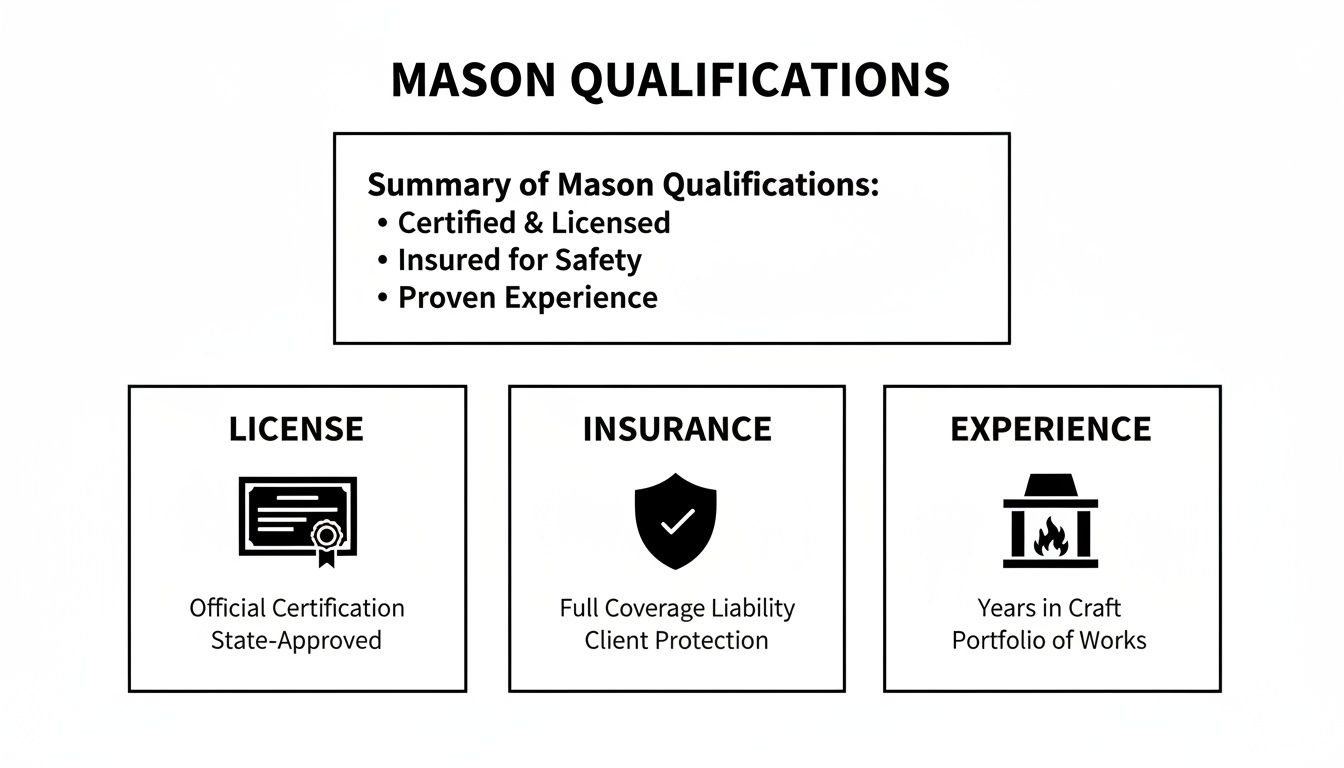
| C-29 Masonry License | A California state-issued license confirming the mason has met experience and testing requirements for all masonry work. | This proves they have the baseline knowledge for structural integrity and building codes. An unlicensed contractor is a massive red flag. |
| Liability & Workers' Comp Insurance | Policies that protect you from financial responsibility for property damage, accidents, or worker injuries on your property. | If an uninsured worker gets hurt or damages your home, you could be held liable. Proper insurance is non-negotiable protection for you. |
| Specialized Fireplace Portfolio | A collection of past projects specifically showing fireplaces and chimneys they have built, not just decorative stone veneer or walls. | This proves they understand the complexities of heat, combustion, and venting. It separates a true fireplace mason from a generalist. |
Think of this table as your initial screening tool. If a potential mason can't check all three of these boxes without hesitation, it's best to walk away and continue your search.
Verify Their C-29 Masonry License First
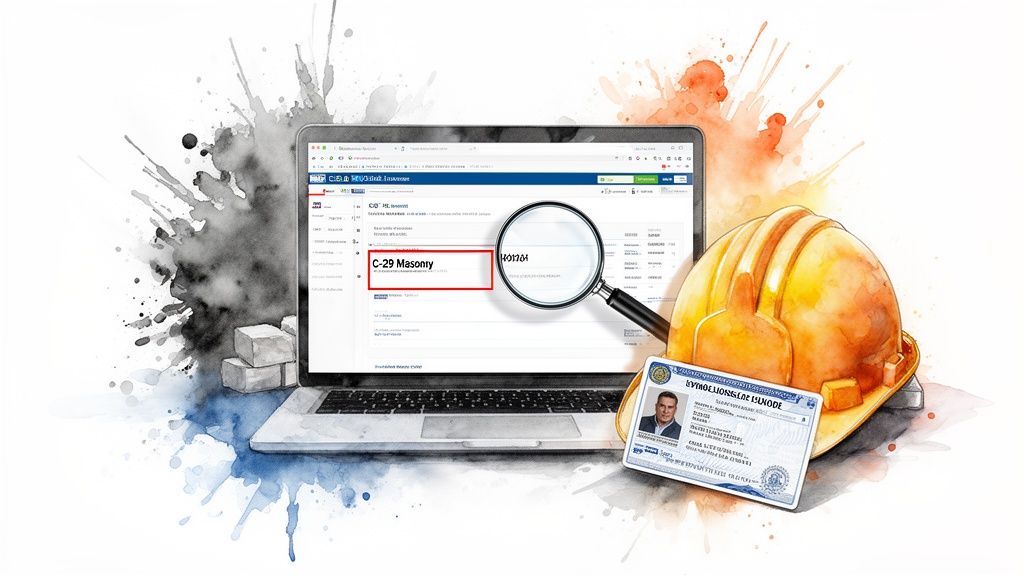
Before discussing designs or stone samples, your very first question for any mason must be about their license. In California, a structural project like a fireplace requires a C-29 Masonry license.
This isn't just a piece of paper; it’s proof that the contractor has passed a demanding state exam covering structural engineering, safety, and complex building codes. A C-29 license signals that a mason understands the physics behind a safe fireplace, and anything less is a gamble you can't afford to take.
How to Quickly Verify a Mason's License
California’s Contractors State License Board (CSLB) makes it incredibly easy to do your homework. They have a public online database that gives you all the essential details in minutes.
Here's the simple process:
- Head over to the CSLB's "Instant License Check" page online.
- Ask the mason for their license number and enter it into the search bar. If they're hesitant, that’s a huge red flag.
- Check the results carefully for an "active" status and confirm the business name matches who you're talking to.
This quick check is the single best way to weed out unqualified operators. For a deeper dive, you can learn more about what a license really tells you about a mason's qualifications in our detailed guide.
Dig Deeper: Insurance and Disciplinary History
The CSLB profile is a goldmine of information beyond just the license status. It’s also where you can find out about their insurance and any disciplinary history.
While on their profile, look for:
- Workers' Compensation Insurance: The details will show if they have it. If the status is "exempt," it means they've sworn they have zero employees; if they show up with a crew, you could be on the hook financially if someone gets hurt.
- Bond Information & Disciplinary Actions: You can also see their bond status and, more importantly, a list of any citations or formal complaints filed against them. A clean record is what you want to see.
Hiring a properly licensed and insured mason protects you from shoddy work that can lead to smoke problems or house fires. The state doesn't take this lightly—California issues over 10,000 citations to unlicensed contractors every year.
Evaluate Their Real-World Experience and Certifications
A California C-29 license is the bare minimum. To really know if a mason is qualified to build a safe fireplace, you must look past the paperwork and dig into their actual experience and advanced training.
A stunning portfolio is nice, but don't let pretty pictures fool you. The glossy photos of a finished hearth don't show the critical work—the foundation, the rebar, the flue—that’s hidden behind the beautiful stone.
Look Past the Pretty Pictures: How to Vet a Portfolio
When a mason hands you their portfolio, your job is to play detective. The parts of a fireplace that keep your family safe are the ones you'll never see again once the job is finished.
Ask to see photos taken during construction, as this is your only chance to glimpse their structural know-how.
Here’s what you’re looking for:
- A Serious Foundation: A masonry fireplace is incredibly heavy and needs its own massive, steel-reinforced concrete footing. You should see pictures of a deep, beefy foundation being poured.
- Proper Rebar Reinforcement: Especially here in California, you need to see a grid of steel rebar running both vertically and horizontally through the masonry for seismic strength.
- Clean Internal Work: The inside of the firebox and smoke chamber should look as meticulous as the exterior stonework, with full, clean mortar joints and precisely cut firebrick.
If a mason is eager to show you these details, it’s a great sign. If all they have are glamor shots of the finished product, you have to wonder what they might be hiding.
The Gold Standard: MCAA Certification
For the highest level of confidence, ask about certifications from top-tier industry organizations. The Mason Contractors Association of America (MCAA) offers a nationally recognized certification that is light-years beyond a basic state license.
To get MCAA certified, a mason has to earn 45 continuing education credits, pass a tough 100-question exam with an 80% score or higher, and complete an OSHA 10-hour safety course. This advanced training ensures your mason is up-to-date on the latest building codes and material science, which dramatically reduces fire risk. You can learn more about these stringent requirements for MCAA certification and see why they are so critical for a fireplace project.
Technical Questions Every Homeowner Should Ask a Mason
A beautiful portfolio is one thing, but a real conversation about the technical side is where you find out if a mason truly knows their craft. The way they handle specific questions will tell you everything you need to know.
An experienced, licensed mason will welcome your questions. A less-qualified contractor might get defensive, brush off your concerns, or give you vague, "don't worry about it" answers, which is a major red flag.
Questions About Firebox and Chimney Design
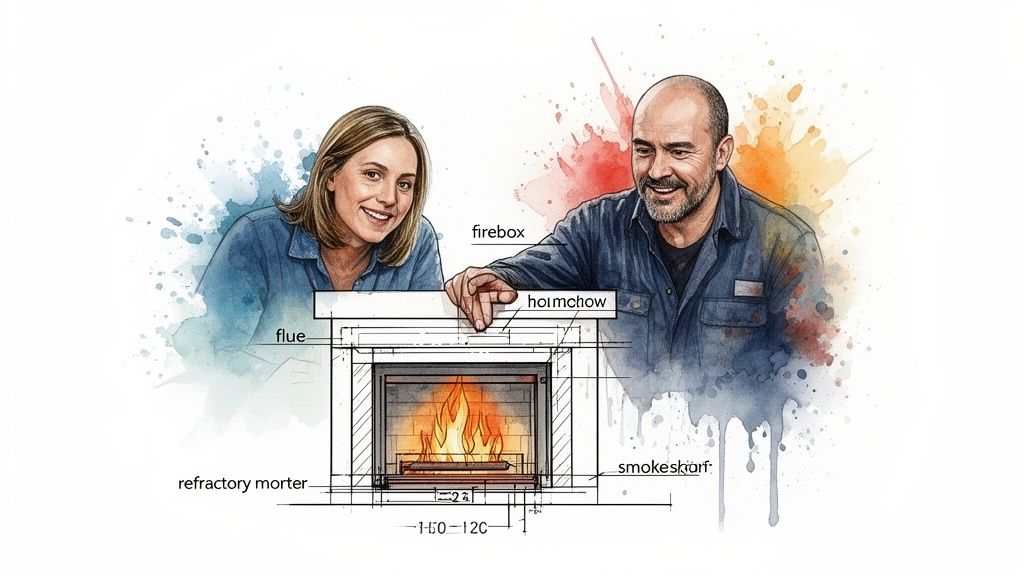
The parts of the fireplace you don't see are the most important. The firebox, smoke chamber, and flue are the engine of the whole system, responsible for controlling heat and drafting smoke.
Here are a few key questions:
- "How do you determine the correct size for the firebox and the flue?" A pro will immediately talk about the crucial relationship between the fireplace opening and the flue liner's area, mentioning industry standards like a 10:1 or 12:1 ratio.
- "What kind of mortar and brick will you be using inside the firebox?" There is only one right answer here: refractory mortar and firebrick. Standard "Type S" or "Type N" mortar is a deal-breaker, as it will break down under extreme heat.
- "Can you walk me through how you build the smoke shelf and smoke chamber?" They should be able to clearly describe building a sloped smoke shelf and parging (coating) the smoke chamber to create a smooth, funnel-like shape.
Good Answers Vs. Red Flags When Interviewing a Mason
Use this comparison to understand what a qualified professional says versus a potentially unqualified contractor.
| Question Topic | What a Qualified Mason Says | Red Flag Response To Watch For |
|---|---|---|
| Flue Sizing | "We'll calculate the flue area based on the fireplace opening, typically using a 10:1 or 12:1 ratio to ensure a strong, consistent draft." | "We just use a standard size; it always works fine." |
| Firebox Materials | "Inside the firebox, we exclusively use firebrick set with high-temperature refractory mortar. It's the only material that can handle the heat." | "We'll use a good, strong Type S mortar for everything." |
| Clearances | "Code requires at least 2 inches of clearance to all interior wood framing and 1 inch to exterior sheathing. We build to ensure we meet that." | "We'll just make sure nothing is touching it. It'll be fine." |
| Permits | "Absolutely, we will pull all the necessary permits. The inspections are a crucial step to verify safety and compliance." | "You don't really need a permit for this kind of job; it just adds cost and time." |
Questions About Safety and Code Compliance
A safe fireplace is one that is built strictly to code—there's no room for interpretation. This is especially true in areas like Carmel Valley and Salinas where wildfire risk is a constant concern.
Be direct with your safety questions:
- "What are the required clearances from combustible materials?" Your mason needs to know these numbers off the top of their head, including a minimum of 2 inches of clearance from interior woodwork required by the International Residential Code (IRC).
- "How will you build the hearth and its extension?" The answer should involve a non-combustible hearth that is structurally part of the fireplace foundation, not just a decorative slab on the floor.
- "Do you handle the permitting process with the local building department?" A true professional will always insist on pulling permits, as it guarantees a third-party inspector will verify the work meets all safety requirements.
Finding a great hardscape contractor is valuable, but a fireplace mason operates on a completely different level of technical skill. Don't be shy about asking these tough questions—your family's safety depends on it.
What a Professional Proposal and Contract Looks Like
Once you’ve finished the interviews, the proposal is where a mason’s professionalism shines through. This document is much more than a price tag—it’s the roadmap for your entire project.
Be wary of vague, one-page estimates, as those are often the first sign of trouble. A good mason will give you a detailed, transparent plan that protects both of you and is a clear indicator that you’ve found someone qualified to build a safe fireplace.
Key Components of a Legitimate Masonry Contract
A serious proposal will be several pages long, leaving no room for guesswork. Your contract should explicitly include:
- A Detailed Scope of Work: The document needs to describe every single step, from digging the foundation to building the firebox, smoke chamber, chimney stack, and final cleanup.
- A Specific Materials List: Don’t accept generic terms. The proposal must name specific materials like the brand of firebrick, type of refractory mortar, and exact flue liner being used.
- A Clear Payment Schedule: Payments should always be tied to project milestones, such as foundation completion, firebox construction, and final inspection approval.
- A Realistic Timeline: Look for a firm start date and an estimated completion date. This proves the mason has a solid game plan and respects your time.
Red Flags to Watch Out For in Proposals
Just as a detailed contract signals a pro, a sparse or demanding one screams risk. To get a better idea of what a legitimate bid includes, it's worth understanding the hidden costs in fireplace quotes that less experienced contractors frequently leave out.
Keep your eyes peeled for these warning signs:
- Large Upfront Payments: A contractor asking for a large upfront cash payment is a huge problem. In California, down payments are limited to 10% of the total contract price or $1,000, whichever is less.
- Vague Details: A handwritten proposal on a generic slip, a missing materials list, or no mention of pulling permits are all major red flags.
Any qualified mason working in Carmel, Salinas, or anywhere in Monterey County knows that permits are non-negotiable for safety and code compliance.
Why Formal Apprenticeships and Training Matter So Much
Building a safe fireplace is a science honed over centuries, not something picked up from a few online videos. This is why a mason's training background is so important—it tells you if they have the foundational knowledge to build a structure that’s both beautiful and safe.
A general contractor who offers to build a “fire pit” often lacks a deep understanding of the thermodynamics involved in a real masonry fireplace. The real difference comes down to formal training and multi-year apprenticeships.
The Value of Hands-On Apprenticeship Training
A proper mason's apprenticeship isn't a quick course; it's a commitment spanning three to four years and demanding over 6,000 hours of on-the-job training. This is where the real learning happens.
An apprentice learns, hands-on, how to construct a correctly proportioned firebox, size a flue for the perfect draft, and work with high-temperature refractory materials. This level of experience is absolutely critical in seismically active areas like Monterey County. If you're curious, you can discover more about masonry training requirements to see just how intensive it is.
How Training Creates a Master Mason
Rigorous, hands-on education separates a true craftsman from someone who just knows how to lay stone. An apprentice doesn't just learn how to build; they learn the why behind every technique that ensures safety and longevity.
This knowledge is especially vital for homes in Carmel, Pebble Beach, and Carmel Valley, where many of us live in wildfire-sensitive zones. A mason with formal training understands how to build a fireplace that meets strict local codes for non-combustible, fire-resistant construction.
Frequently Asked Questions About Hiring a Mason
1. How do I know if a mason is qualified to build a safe fireplace?
Look for a valid C-29 Masonry License in California, proof of liability and workers' compensation insurance, and a portfolio with in-progress photos of actual fireplaces. A qualified mason will confidently answer technical questions about firebox design, flue sizing, and refractory materials.
2. Is an outdoor fireplace safer or easier to build than an indoor one?
No, this is a common misconception. Outdoor fireplaces require the same structural integrity, proper foundation, and precise flue design to manage heat and smoke safely. Poor construction can lead to cracking and fire hazards, regardless of location.
3. What is the biggest red flag when getting a fireplace quote?
A vague, one-page quote is a major red flag, as is a request for a large cash deposit upfront. In California, a down payment cannot exceed $1,000 or 10% of the project cost, whichever is less.
4. Why is a C-29 license so important for a fireplace?
A C-29 license proves the mason has passed California's rigorous testing on structural masonry, safety codes, and engineering principles. It is your primary assurance that they possess the technical knowledge required to build a structure that contains a live fire safely.
5. What materials are essential for a safe firebox?
A safe firebox must be constructed using firebrick and high-temperature refractory mortar. If a contractor suggests using standard brick or Type S mortar inside the firebox, they are not qualified to build a safe fireplace.
Choosing the right professional is the single most important step you can take to ensure your new fireplace will be a safe, beautiful source of warmth for your family for decades. Given the unique challenges of our coastal climate and the wildfire risks in Monterey County, bringing in a licensed, local expert isn't just a good idea—it's essential.
