
Homeowners often ask, "do I actually need a licensed masonry contractor for small jobs in California?" The answer often comes down to one key number: $500. California law states that if the total cost of your project—including both labor and materials—is $500 or more, you must hire a licensed contractor.
This isn't just a suggestion; it’s a critical legal safeguard. It’s in place to protect you, your home, and your investment from the risks of poor workmanship and liability.
Decoding the $500 Rule for California Homeowners
The confusion around hiring a pro for what seems like a minor masonry fix is understandable. You might see a few cracked patio pavers and wonder if it justifies calling a licensed specialist. Many homeowners hear mixed advice from handymen or online forums, adding to the uncertainty.
The California State License Board (CSLB) established the $500 threshold to draw a clear line. It separates small, odd jobs from professional work that requires proven expertise, insurance, and accountability.
This decision guide clears things up. It walks you through the simple logic of California's hiring rule, helping you see if your project’s total cost means you need a licensed mason.
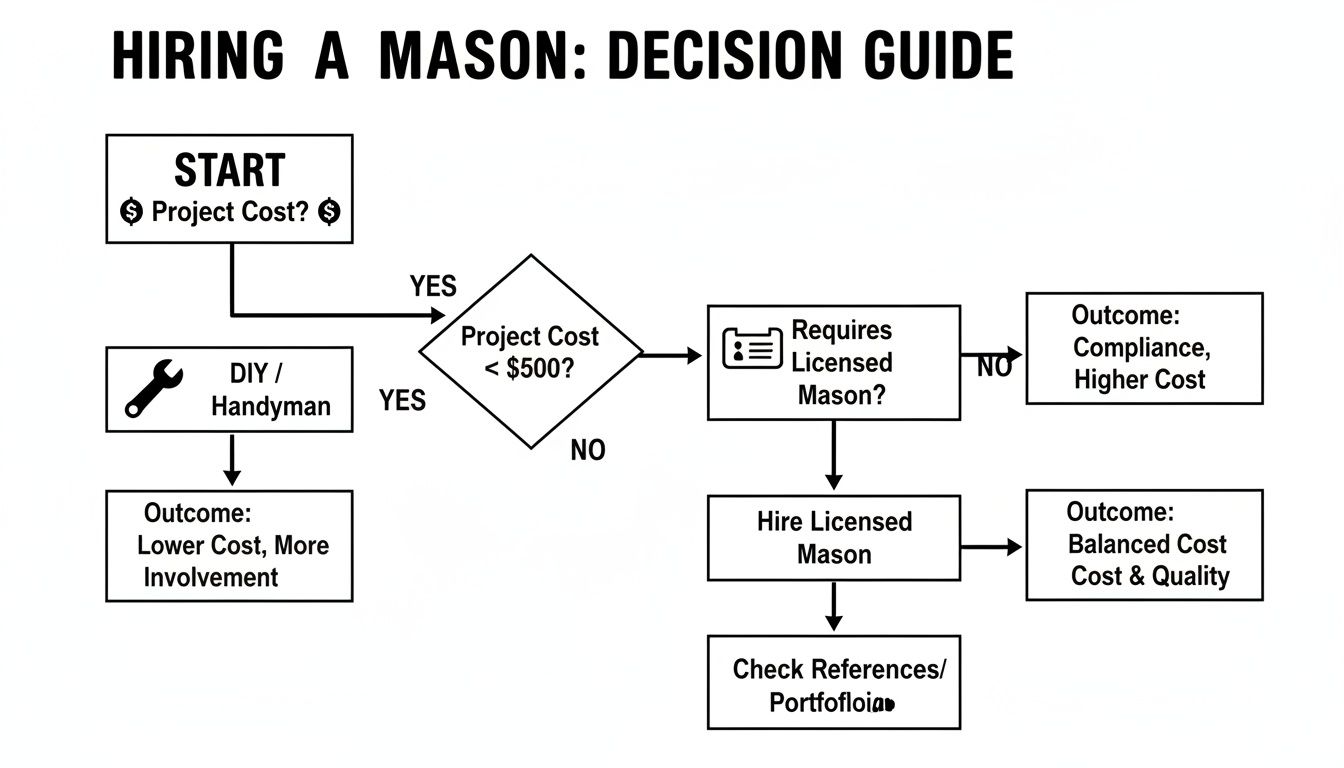
As you can see, it all comes down to that total project cost. Use the $500 rule as a clear guideline, not a loophole.
The C-29 Masonry License: Your Mark of a True Professional
When your masonry project crosses that $500 line, what exactly are you looking for? The specific credential you need is the C-29 Masonry License.
This license is far more than a business permit. It’s a hard-earned state certification confirming the contractor has verified experience, passed difficult exams, and demonstrated the knowledge to ensure structural integrity.
Why This Rule is Crucial in Monterey County
For homeowners in Salinas, Monterey, and Carmel, this rule is about practical protection. Our unique coastal climate, local building codes, and wildfire safety standards place special demands on construction.
A licensed C-29 contractor has the specific expertise to navigate these local challenges. They ensure even a "small" job is done right the first time, preventing expensive future repairs. To dig deeper, you can learn more about the truth behind the $500 rule and how it affects your project.
Licensed Contractor vs. Handyman: A Quick Guide
This table breaks down common scenarios. Use it as a quick reference to see where your project falls and who you should call.
| Project Scenario | Total Cost (Labor + Materials) | Licensed Contractor Required? | Key Consideration |
|---|---|---|---|
| Repairing 3-4 loose bricks on a garden wall | $250 | No | The total cost is under the $500 threshold, making it a handyman-appropriate job. |
| Repointing a small 5-foot section of a chimney | $475 | No | Even though it involves a critical structure, the project cost is the deciding factor. |
| Installing a small 15 sq. ft. paver landing | $650 | Yes | The combined cost of pavers and labor exceeds the $500 limit. |
| Building a new stone mailbox pillar | $1,200 | Yes | This is a structural project with a cost well over the legal threshold. |
| Resetting a wobbly stone step | $300 | No | A straightforward repair that falls into the "minor work" category. |
| Fixing a 10-foot crack in a concrete walkway | $700 | Yes | The job's scope and cost push it firmly into licensed contractor territory. |
Ultimately, the rule provides a clear line of defense for homeowners. While a handyman is great for minor fixes, anything more substantial requires the proven skill, insurance, and accountability that only a licensed professional can provide.
Why That 'Small' Masonry Job Is Bigger Than You Think
It’s tempting to look at a few cracked patio pavers or some worn-out mortar and think, "How hard can that be?" On the surface, it seems like a quick fix. But with masonry, the real story is almost always hidden just beneath what you can see.
That small masonry issue is often the first warning sign of a bigger problem. A cracked walkway, for example, is rarely just about the crack itself; it’s a symptom of a deeper issue.
What Lies Beneath the Surface
A crack could indicate that the base underneath wasn't compacted correctly or that water isn't draining properly. Slapping new mortar on top without fixing the root cause is like putting a bandage on a broken arm—it hides the problem but doesn't solve it.
This is where a licensed C-29 masonry contractor proves their worth. They are trained to analyze subtle clues that an unlicensed handyman would miss.
Here’s what they’re looking for:
- Local Soil Conditions: The heavy clay soils around Salinas expand and contract dramatically. A real pro knows how to build a foundation that can handle our specific local geology.
- Drainage and Water Intrusion: For anyone living near the water in Carmel or Pebble Beach, moisture is the enemy. A licensed mason ensures a repair also acts as a barrier against salt air and rain.
- Material Compatibility: Using modern mortar to patch a historic brick wall can destroy the old brick. A professional knows how to match materials for a repair that lasts.
Beyond the physical work, small jobs sometimes require bringing the repaired section up to current standards. Properly understanding building code requirements for repairs is a crucial part of a licensed contractor's expertise.
The True Cost of Cutting Corners
Hiring someone based on a cheap quote often means you're paying for a cosmetic cover-up, not a real solution. That poorly patched walkway becomes a serious trip hazard. A "repaired" retaining wall could give way during the next big winter storm.
Choosing a licensed professional isn't about bureaucracy. It’s a smart investment in the safety, integrity, and value of your home.
The Hidden Risks of Hiring Unlicensed Help for Small Jobs
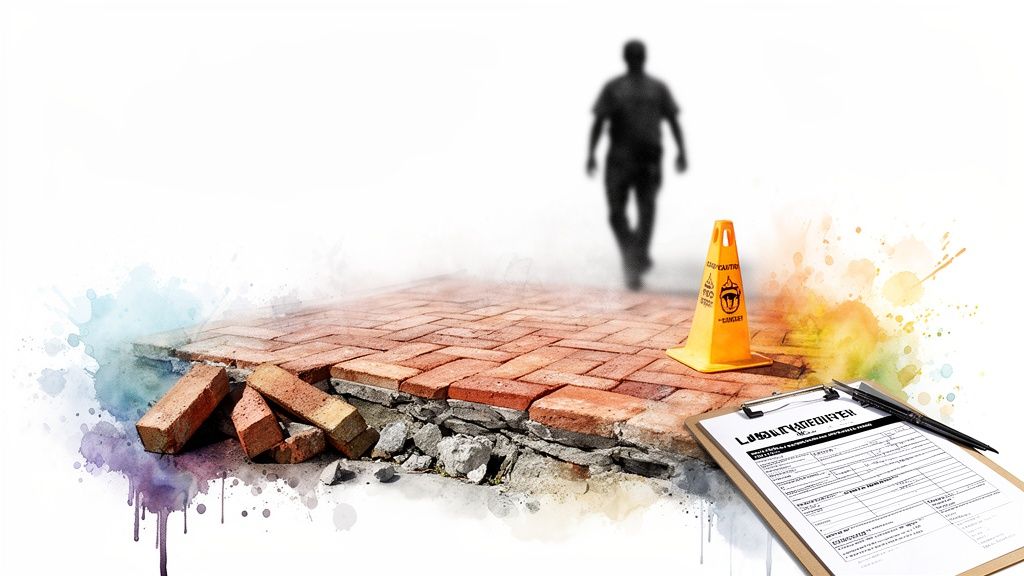
It can be tempting to hire an unlicensed worker for a small masonry job to save a few bucks. But this decision is a huge gamble with your home, finances, and safety. The risks are serious legal and financial liabilities that fall squarely on your shoulders.
When you hire an unlicensed person, you become their employer in the eyes of the law. If they get hurt on your property, you could be personally liable for their medical bills and lost wages. Because they don't carry workers' compensation insurance, that risk transfers directly to you.
Financial and Quality Control Issues
Beyond injury risk, there’s a complete lack of professional accountability. Licensed contractors are bonded, which is your safety net if they do poor-quality work. An unlicensed individual offers no such guarantee.
Without that protection, homeowners often face frustrating problems:
- Ghosting: The worker takes your deposit and disappears, leaving a half-done project.
- Shoddy Work: The final product looks nothing like what you agreed on. Think uneven stones, mismatched mortar, or an unstable wall.
- No Recourse: When things go wrong, you have no performance bond to claim against and almost no legal power to force them to fix mistakes.
California regulators are cracking down on this issue. In a single recent sting operation, the state issued 119 legal actions against unlicensed contractors, underscoring that enforcement is a real and growing risk (Stonecap Masonry Inc., 2024 Strategic Report).
The Problem of Code Compliance
Unlicensed workers rarely know—or simply ignore—local building codes in communities like Pebble Beach or Carmel Valley. A poorly built retaining wall might not meet seismic safety standards. A new patio could lack proper drainage for our coastal climate.
Even a beautiful addition, like one of our custom-built fire pits, must follow strict safety codes. Understanding the principles of contractor management makes it clear why hiring a licensed professional is the only way to protect your investment.
Understanding California's C-29 Masonry License
When you search for a professional, you'll see the term C-29 Masonry License. This is the gold standard for masonry professionals in California. It's the state’s way of verifying that a contractor is a true specialist in their craft.
Hiring someone with a C-29 license means you're bringing in a professional who has cleared high hurdles. It signals a commitment to quality, safety, and lasting work.
What It Takes to Earn a C-29 License
The C-29 license isn't easy to get. The state process is designed to weed out anyone who lacks deep experience and business knowledge.
To apply, a mason must prove at least four years of hands-on, journeyman-level experience. This has to be backed up with solid proof. You can see the full breakdown on the official CSLB website.
If they clear that hurdle, they then have to pass two tough exams:
- The Masonry Trade Exam: This covers the nitty-gritty of the craft, from concrete foundations and retaining walls to setting brick and stone.
- The Law and Business Exam: This ensures the contractor knows construction law, workers' compensation requirements, and ethical business practices.
When you choose a C-29 contractor, you’re hiring someone who has proven they can build things that are both beautiful and structurally sound.
Why This License Matters for Your Project
The C-29 license is your best assurance that the person working on your home is a legitimate professional. It tells you they understand the unique challenges of masonry work. This expertise is what prevents the small, costly mistakes that can cause a project to fail years down the road.
Hiring a licensed pro gives you peace of mind, knowing the work is backed by verified skill and legal accountability. When you're ready to hire a masonry contractor, this is the credential to look for.
The Benefits of Hiring a Licensed Mason, Even for Small Projects
You might think that for a small crack in a walkway, hiring a licensed professional is overkill. But the decision to bring in a licensed C-29 mason is one of the smartest investments you can make, no matter the size of the job.
A licensed contractor is your safety net. They are legally required to carry general liability insurance and a performance bond. This means if someone gets hurt on your property, you're covered. And if the work isn't done right, you have a clear path to get it fixed.
Ensuring Code Compliance and Lasting Quality
One of the biggest perks is knowing the job will be done to code. A licensed mason understands local building regulations, from HOA rules in Pebble Beach to fire-safety codes in Carmel Valley.
This is especially critical for homeowners in Pacific Grove or Carmel Valley. A repair that isn't up to snuff can void your HOA approval or even your homeowner's insurance. To see why this matters so much, you can learn more about how C-29 licensing connects to building safe structures.
A licensed mason doesn't just put a bandage on the visible problem; they figure out what caused it in the first place. That professional approach is what keeps a tiny issue from snowballing into a massive, expensive failure down the line.
The Value of Professionalism and Durability
When you hire a licensed professional, the whole experience is different. You get a clear, detailed proposal that spells out the scope, materials, and timeline. Homeowners often complain about receiving unclear bids from unlicensed workers, and a professional contract solves this problem (Stonecap Masonry Inc., 2024 Strategic Report).
In the end, it comes down to craftsmanship that adds real value to your home. A professionally repaired walkway is built to stand up to our coastal weather for years. You can see this commitment to quality in professionally installed patios and walkways that truly elevate a property.
How to Verify a Masonry Contractor's License in California
So, how do you protect yourself from the risks of unlicensed work? California gives every homeowner a straightforward tool to check any contractor in minutes.
Always ask for their contractor's license number first. A true professional will provide it without hesitation. If they make excuses, that's a major red flag.
Once you have that number, you can use the Contractors State License Board (CSLB) online portal to see their status instantly. This single check is the most important step to ensure you're hiring a legitimate professional.
Using the CSLB License Check Tool
The CSLB’s "Instant License Check" service is your best friend in this process. It gives you a complete, up-to-date snapshot of the contractor’s business.
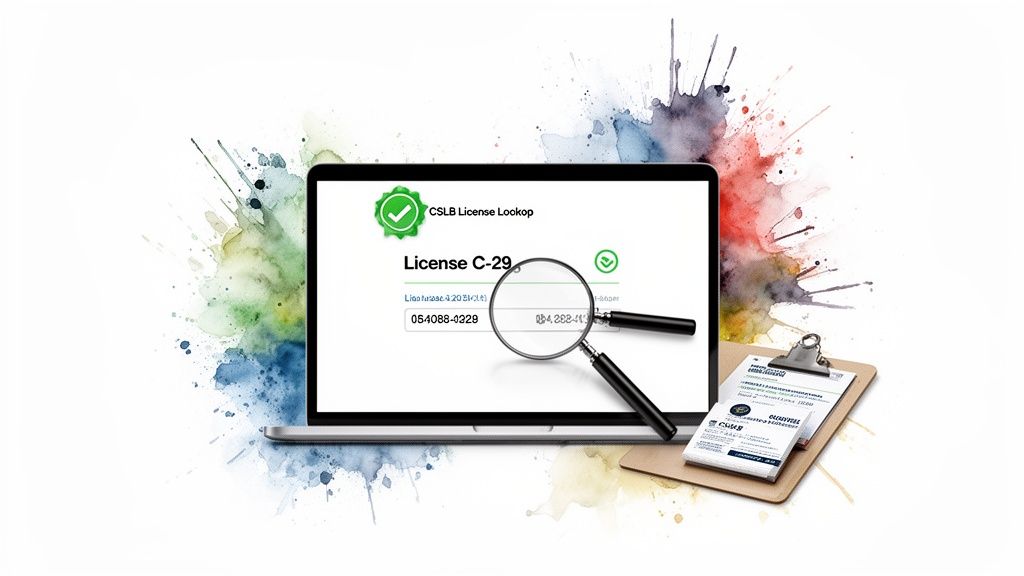
From the portal, you can immediately find out:
- Is their C-29 Masonry license active and in good standing?
- Do they have the required license bond?
- Do they carry workers' compensation insurance?
This level of transparency separates the pros from the pretenders. And with the fact that Central Coast licensing rules are tightening, this verification step has never been more important.
Frequently Asked Questions About Small Masonry Jobs
It's normal to have questions about California's rules. Here are some of the most common ones we hear from homeowners.
Does the $500 limit include materials I buy myself?
Yes, absolutely. The CSLB considers the total value of the job, including all labor and materials, regardless of who buys them. This is a common misconception that can put homeowners at legal risk.
What if someone offers to split the job into smaller invoices to stay under $500?
This is a major red flag and an illegal practice known as "structuring." An unlicensed contractor may suggest this to get around the law, but it leaves you with zero legal protection if something goes wrong.
Is a handyman's business license the same as a C-29 Masonry License?
Not at all. A local business license just allows someone to operate in a specific city. A C-29 license is a state-level certification proving the contractor has passed rigorous trade exams, documented years of experience, and carries the required insurance and bonding.
Are there exceptions to the $500 rule for emergency masonry repairs?
No, the law generally does not bend for emergencies. In fact, for urgent structural issues like a storm-damaged chimney, it’s even more critical to hire a licensed, insured professional to ensure the repair is stable, safe, and up to code.
Why is hiring a licensed contractor important for wildfire-prone areas like Carmel Valley?
In high-risk fire zones, using the right fire-resistant materials and construction techniques is essential for safety and code compliance. A licensed C-29 contractor understands local fire codes, ensuring that features like patios, walls, and fire pits are built to protect your home, not endanger it.
Making the right choice protects your home, your investment, and your peace of mind. This is especially true given the Monterey Peninsula's unique coastal climate, local soil conditions, and fire safety codes. If you're unsure whether your project needs a licensed professional, the safest bet is always to consult an expert.
The team at Stonecap Masonry Inc. is always here to provide clarity and help you get the job done right. You can find out more by visiting us at https://stonecapmasonry.com.
