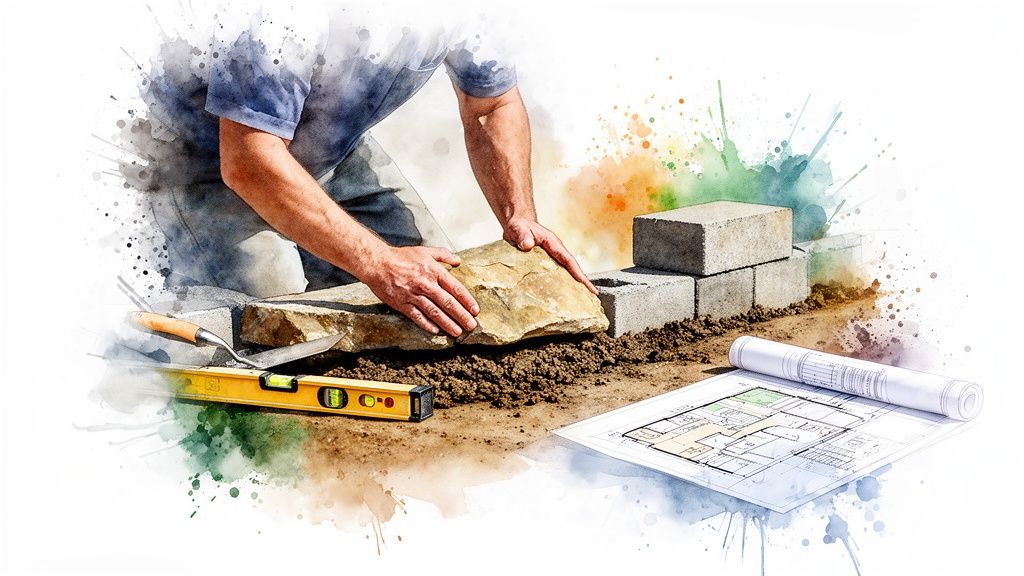
What exactly is a hardscape contractor? They are the master builders for your outdoor world, specializing in the permanent, non-living structures that form the backbone of your landscape. This includes stone patios, engineered retaining walls, outdoor kitchens, and walkways.
Their work is about engineering a space that lasts. A professional hardscape contractor ensures flawless base preparation, smart drainage, and unshakeable structural integrity, creating a functional and beautiful extension of your home.
What a True Hardscape Craftsman Actually Does
When you partner with a genuine hardscape professional, you are investing in deep structural expertise. Their work becomes the soul of your outdoor living area, preventing future problems like cracked concrete, sinking pavers, or a leaning retaining wall.
A pro’s job is to fuse artistry with engineering. They transform raw materials like natural stone and concrete pavers into something both beautiful and built to stand the test of time, especially here in the Monterey Bay area.
Beyond the Surface Level Design
Frankly, almost anyone can lay down some pavers. A true hardscape contractor, however, builds an entire system designed for resilience, with the most important work happening underground.
For homeowners in places like Carmel or Salinas, this means a contractor must know how to handle our diverse soil types. Their core responsibilities include:
- Proper Base Preparation: This is non-negotiable. It involves excavating to a precise depth, then installing and compacting aggregate layers to create a rock-solid foundation that prevents shifting and sinking.
- Engineered Drainage Solutions: A seasoned contractor will design your patio with an exact slope to shed water. They might also integrate systems like French drains to handle Monterey’s heavy winter rains, protecting your hardscape and home foundation.
- Structural Integrity for Walls: Building a retaining wall in a hilly area like Carmel Valley is a science. It requires a deep understanding of soil pressure, proper reinforcement, and local building codes to ensure the wall will never fail.
Translating Vision into a Durable Reality
An expert hardscape contractor is the critical link between your dream design and a structurally sound reality. They guide you in selecting the right materials for both aesthetics and long-term performance. In a wildfire-prone zone, they will recommend specific non-combustible materials to enhance your home's safety.
This is what sets a hardscape contractor apart from a general landscaper. A landscaper focuses on "softscape"—the living elements like plants and trees. The hardscape contractor builds the permanent, foundational structures that define the entire space.
Their knowledge of building codes and construction techniques guarantees your outdoor kitchen or stone patio will withstand our coastal weather. For modern design ideas, see our guide on stone patio trends that make for a top home upgrade.
Your First Step: Verifying Hardscape Contractor Credentials

Before discussing designs, you must have the most important conversation: verifying credentials. Hiring someone without the proper license, bonding, and insurance is a major gamble.
These aren't just pieces of paper; they are your primary defense against shoddy work and financial disasters. Think of them as a three-legged stool of protection—take one away, and the whole thing collapses.
The C-29 Masonry License Explained
In California, if a masonry project costs $500 or more, the contractor must have a state-issued license. For hardscape projects, this is the C-29 Masonry License.
The C-29 license proves a contractor has demonstrated hands-on experience and passed exams on the trade. Hiring an unlicensed operator for a project in Monterey Bay, with our unique soil and drainage challenges, is a risk that can lead to expensive failures.
You can and should verify a contractor's license in seconds. The Contractors State License Board (CSLB) offers a free, instant online search to check their license status, bonding info, and any past disciplinary actions.
Understanding Bonding and Insurance
Bonding and insurance protect you in different ways, and a legitimate contractor will have both. A surety bond is your financial backstop if the contractor fails to complete the job or pay suppliers.
Liability and workers’ compensation insurance protect you from accidents. If equipment damages your property or a worker gets hurt, their policies cover the costs. Without it, those bills could fall on you.
Contractor Credential Checklist
Use this table to keep these critical items straight when interviewing a hardscape contractor.
| Credential | What It Means for You | How to Verify |
|---|---|---|
| State License (C-29 Masonry) | Confirms they have met state standards for experience and knowledge in masonry. | Ask for their license number and check it on the CSLB website. |
| Surety Bond | A financial guarantee that protects you if the contractor fails to complete the job or pay bills. | The CSLB license check will show if their bond is active and on file with the state. |
| General Liability Insurance | Covers accidental damage to your property or a neighbor's during the project. | Ask for a Certificate of Insurance (COI) and call the insurance agent listed to confirm it's current. |
| Workers' Compensation | Covers medical costs for any of their employees injured while working on your property. | The CSLB check will note if they are exempt (no employees) or have a policy on file. If they have a crew, they must have it. |
Always ask for proof and verify it yourself. Any hesitation from a contractor is a massive red flag.
Why Hiring Unlicensed Is Never Worth the "Discount"
A low-ball bid from an unlicensed operator is tempting, but that "savings" can evaporate instantly. A persistent labor shortage continues to challenge our industry, with residential installers facing projected 6% wage hikes in 2025. This pressure can tempt some to cut corners on insurance and licensing. (Source: 2025 Hardscape Report).
A contractor who invests in proper credentials is a serious professional committed to accountability. It is also worth reading how Central Coast licensing rules are tightening for homeowners.
Questions That Reveal a Contractor's True Expertise
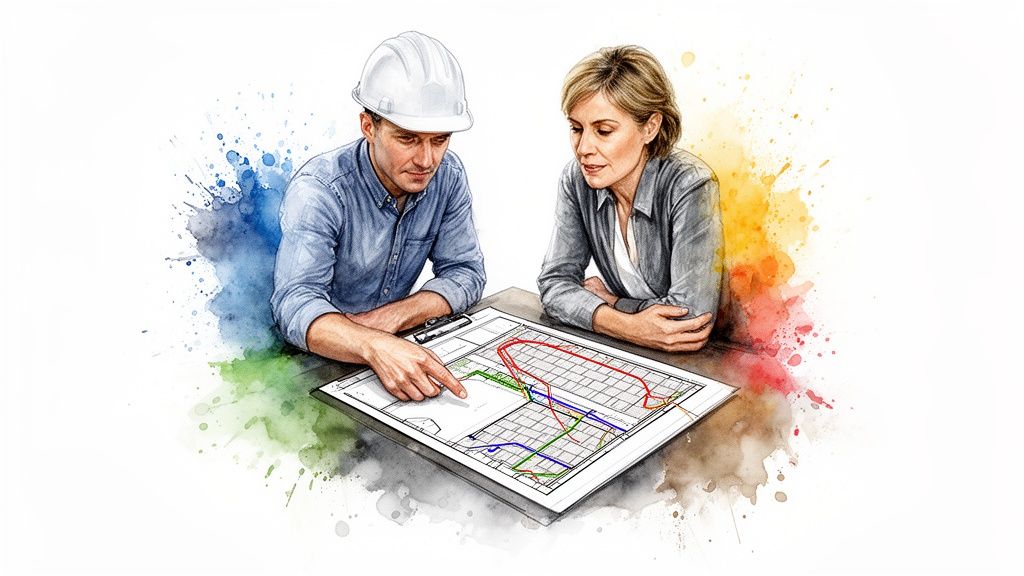
Once you've confirmed a contractor's credentials, the real evaluation begins. The questions you ask can separate a crew that just lays pavers from a true hardscape professional who engineers lasting outdoor spaces.
Shallow questions get shallow answers. You need to probe their process, local knowledge, and problem-solving skills to learn about their commitment to quality.
Probing Questions About Process and Materials
A seasoned pro will welcome detailed questions about their methods. Vague or dismissive answers are a huge red flag.
Try asking a few of these to gauge their technical skill:
- "Can you walk me through your exact process for base preparation on a paver patio, especially considering Carmel's sandy soil?" A solid answer will cover excavation depth, the type of aggregate used (like Class II base rock), compacting in layers (or "lifts"), and why this is vital.
- "How do you ensure proper drainage on a sloped property in Pacific Grove to handle our heavy winter rains?" Look for them to mention calculating the right slope (usually a quarter-inch per foot), using permeable materials, or integrating solutions like French drains.
- "What type of reinforcement do you use for a retaining wall over four feet tall, and why?" A knowledgeable contractor will immediately talk about using geogrid, rebar, and proper backfill with drainage stone to fight hydrostatic pressure.
If they hesitate or can't give specifics, it suggests they lack experience or cut corners. The quality of a hardscape project is determined by what you can't see—the base, drainage, and structural support.
Questions That Test Local Expertise
A hardscape contractor's familiarity with Monterey Bay's coastal weather, diverse soil types, and city codes is non-negotiable. Their answers should show they have real-world experience building in our community.
To test their local knowledge, try these inquiries:
- "What local suppliers do you recommend for natural stone, and why do you prefer working with them?" This shows they're established in the local industry and know where to source quality materials.
- "Have you completed projects in Pebble Beach or Carmel Valley before? Can you give me addresses of some completed work?" A reputable contractor will be proud of their work and should readily provide a list of local projects. You can see our standards in our online portfolio.
- "How do you approach projects in a high-fire-risk zone to ensure the hardscape contributes to defensible space?" A competent contractor will discuss using non-combustible materials like stone and pavers to create fire-safe zones around the home.
Understanding Their Business Practices
Finally, ask questions about their professionalism and communication. Ghosting, missed deadlines, and surprise costs are common homeowner pain points. (Source: Stonecap Masonry Inc. Strategic Report, 2024).
Get a feel for their business operations to set clear expectations:
- Who is my main point of contact on-site every day?
- How do you handle project changes or unexpected issues?
- What does your project warranty cover, and for how long?
A contractor who gives clear answers shows transparency and a commitment to a smooth client experience.
Making Sense of Hardscape Costs and Contracts
Getting quotes for your hardscape project can feel like comparing apples to oranges. A rock-bottom bid often means something crucial is being left out.
The hardscape market is booming, expected to jump from $15 billion in 2025 to $22 billion by 2033, with residential projects accounting for 68% of that work. (Source: this outdoor hardscape service report). This makes it more important than ever to know what you’re paying for.
What’s Really Behind the Price Tag?
A professional bid is a careful calculation based on several key factors. The main cost drivers you should see reflected in an estimate are:
- The Materials You Choose: Premium natural stone like quartzite costs far more than standard concrete pavers. Material selection is often the biggest line item.
- The Complexity of the Design: A multi-level terrace with curved seating walls and a built-in kitchen requires more skill and labor than a flat, rectangular patio.
- Access to the Site: Tight access, common in Pacific Grove, can dramatically increase labor hours if materials must be hauled by wheelbarrow.
- The Unseen Foundation: A cheap bid often means a contractor is skimping on base preparation. A true pro building a driveway in Salinas knows to excavate deep enough to prevent future sinking.
The Problem with the Lowest Bid
The cheapest quote is almost never the best deal; it's a massive red flag. It tells you a contractor is likely skipping essential steps, using subpar materials, or isn’t carrying the right insurance.
A suspiciously low bid often means the contractor is saving money on the base. Skimping on proper excavation and compaction all but guarantees your new patio will fail within a few years, requiring a costly replacement. Be sure you understand the truth about the $500 rule for contractors.
Your Contract: The Most Important Document
Once you've found your hardscape contractor, the contract is your project's blueprint for success. It is a legally binding agreement that protects both of you.
A rock-solid contract should always spell out these key items:
- A Detailed Scope of Work: This should precisely describe every task, from demolition to final cleanup, leaving no room for assumptions.
- A Specific Materials List: The contract must list the exact materials, including manufacturer, color, and style.
- A Clear Payment Schedule: California law forbids a contractor from asking for a down payment of more than 10% or $1,000, whichever is less.
- How Changes Are Handled: A good contract outlines the "change order" process for making adjustments, including how they will be priced and approved in writing.
- An Estimated Timeline: The contract should give you an estimated start and completion date, providing a realistic timeframe.
A detailed contract is a sign you’re working with a true professional who values transparency.
Meeting Monterey County Codes and Wildfire Safety Rules
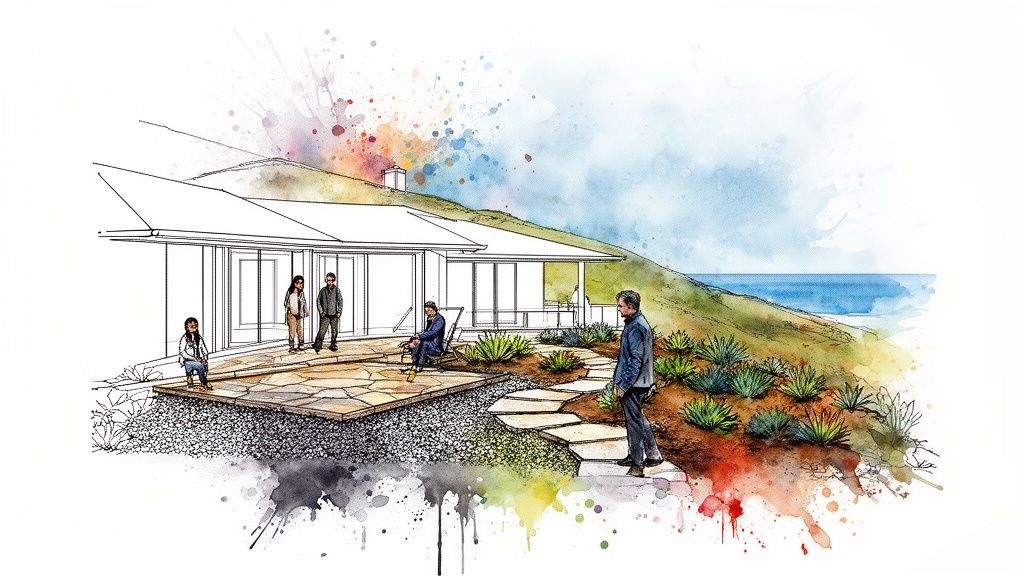
Crafting a stunning hardscape in Monterey County involves more than just design. Any professional hardscape contractor knows every project must be built on a foundation of safety, compliance, and local knowledge.
Navigating California's building codes and wildfire safety regulations is a critical step in protecting your home. These rules exist to ensure a retaining wall in Carmel can handle soil pressure or an outdoor fireplace in Pebble Beach won't spread embers.
Why Permits and Code Adherence Matter
Pulling the right permits is the first step in a compliant project. The permitting process ensures a qualified third-party inspector signs off on the construction plans, verifying they meet minimum safety standards.
For example, most local jurisdictions require a permit for:
- Retaining Walls: A wall over four feet tall (measured from the base of the footing) almost always needs an engineered plan and a permit.
- Outdoor Fireplaces & Fire Pits: These structures have strict rules about their distance from your house and property lines to prevent fire spread.
- Patios & Decks: Larger installations, especially on a slope, often require professional review to ensure they're stable.
A contractor who suggests skipping permits is exposing you to huge risks, including fines and orders to demolish the work.
Wildfire Resilience: A Non-Negotiable Local Priority
For anyone living in Monterey County, building a wildfire-resilient landscape is a top priority. A sharp hardscape contractor is a key partner in creating what fire officials call defensible space.
This involves using non-combustible materials to create a "fire break" around your home. Strategically placed stone patios, gravel paths, and concrete pavers interrupt vegetation, robbing an approaching wildfire of fuel.
This isn’t just a "nice-to-have"; it's a central part of local building codes. You can learn more about how fire zones are changing stone patio design.
Local Knowledge is Everything
Beyond state codes, every town has its own rules. A contractor with deep roots in Monterey Bay will know how to handle the specific design review boards in Carmel or the soil conditions in the hills above Salinas.
This firsthand experience is priceless. It means your project gets approved without delays and is properly engineered for our unique coastal climate, seismic activity, and fire risks.
FAQs About Hiring a Hardscape Contractor
1. What is the main difference between a hardscape and landscape contractor?
A hardscape contractor builds the permanent, non-living structures like stone patios and retaining walls. A landscape contractor focuses on the "softscape," which includes plants, soil, and irrigation.
2. How long should a new paver patio last?
A professionally installed paver patio should last 25 to 50 years. Its longevity depends almost entirely on the quality of the base preparation underneath it, which prevents sinking and shifting.
3. Do I need a permit to build a retaining wall in Monterey County?
Yes, in most cases. If a retaining wall is over four feet tall (measured from the bottom of the footing), it requires an engineered design and a building permit to ensure it is structurally sound.
4. How much of a deposit can a contractor legally ask for?
In California, a contractor cannot ask for a deposit of more than 10% of the total contract price or $1,000, whichever amount is less. This law protects homeowners from financial risk.
5. Can a hardscape contractor fix drainage issues?
Absolutely. A skilled hardscape contractor engineers solutions to manage water, using precise slopes, permeable pavers, or French drains to guide water away from your home and prevent erosion.
Choosing the right professional for your project on the Monterey Peninsula is essential. Always consult a licensed and insured hardscape contractor who understands our local climate, soil conditions, and fire safety codes. A well-built hardscape is a lasting investment in your home's safety and value. Learn more about our craftsmanship.
