
Here’s the simple truth about hiring a licensed mason: a license is the absolute bare minimum, not a gold seal of masterful craftsmanship.
Think of it as a driver's license—it proves they know the rules of the road, but it doesn't tell you if they're a world-class race car driver.
A license confirms that a contractor has met California's legal requirements for insurance, bonding, and basic trade knowledge. It’s your safety net against fraud and liability, but it tells you nothing about whether their work will be beautiful, durable, and something you'll be proud of for decades to come.
What a Masonry License Guarantees vs. What It Doesn't
For many homeowners in Monterey and Carmel, seeing a contractor’s license number feels like the ultimate sign-off. It's a common and understandable mistake to assume that a licensed mason is automatically an expert.
However, recent insights show that homeowners lack the technical know-how to judge masonry quality and feel anxious about poor workmanship (Stonecap Masonry Inc., Strategic Report, 2024). They assume licensing equals skill because it’s the only measurable factor they understand—yet forums are filled with stories of licensed contractors delivering uneven results.
Putting too much faith in that number alone means you’re overlooking the most important thing: the actual quality of their work.
The Legal Baseline of a License: What It Proves
A California C-29 Masonry License confirms a few non-negotiable things. First, the contractor has passed state exams covering business law, safety regulations, and the fundamentals of the trade.
Second, it means they carry the required insurance and bonds. This is what protects you if something goes wrong.
But here’s the catch: the state exam doesn't test for artistry, precision, or deep knowledge of advanced masonry techniques. It won't tell you if a mason knows how to build a retaining wall that can handle the unique soil in Salinas, or if they can choose the right mortar to withstand the salty air in Pacific Grove.
The Craftsmanship Reality: What It Doesn't Prove
What a license doesn’t guarantee is artistry or long-term durability. True craftsmanship—the kind that ensures your project won't crack, settle, or fail prematurely—must be verified separately.
This is where you must shift your focus from credentials to demonstrated skill. A license proves legality, bonding, and insurance—not mastery of the craft.
The infographic below breaks down what a license guarantees versus the craftsmanship qualities you still need to verify.
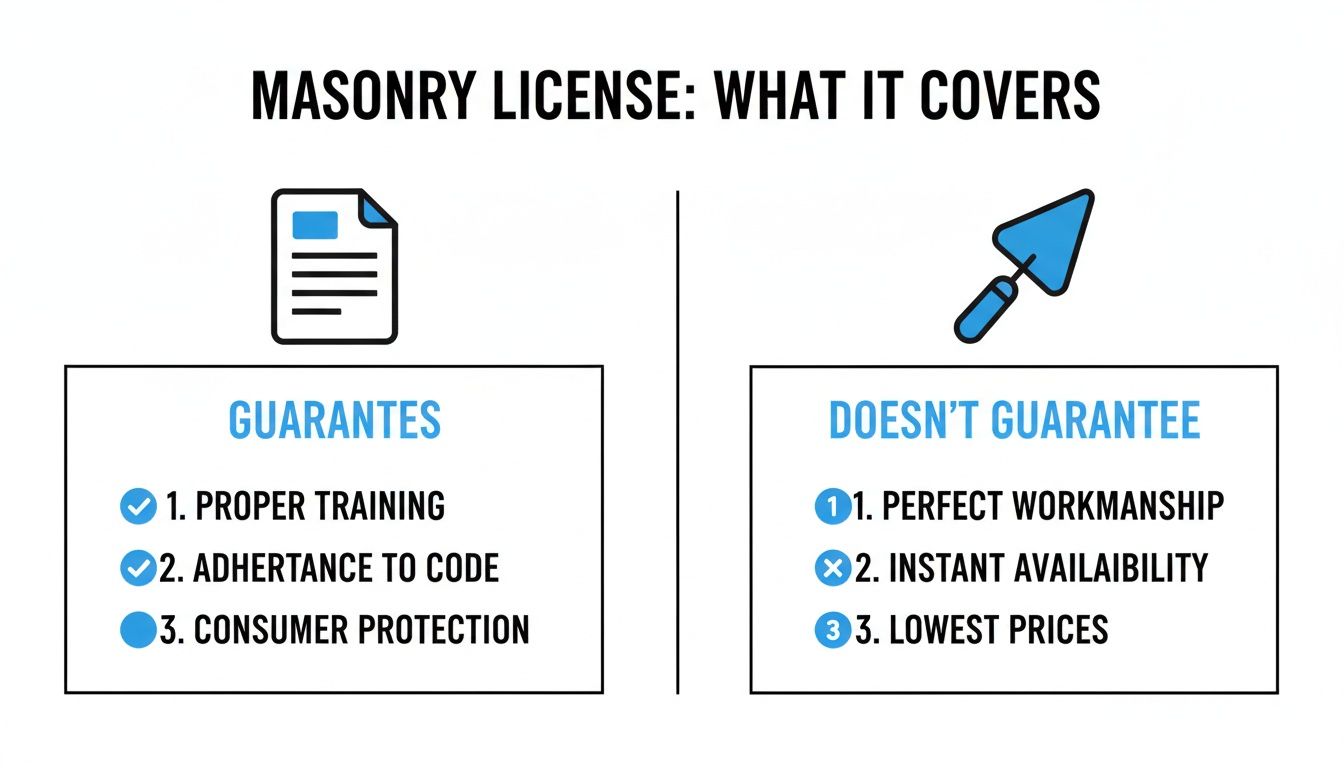
This table puts it into perspective:
What a Masonry License Really Means
| Credential | What It Guarantees (The Legal Baseline) | What It Doesn't Guarantee (The Craftsmanship Reality) |
|---|---|---|
| State License (e.g., C-29) | Passed basic state exam on law and trade. | Advanced skill, artistry, or problem-solving. |
| General Liability Insurance | Financial protection for property damage. | High-quality work that won't fail prematurely. |
| Workers' Comp Insurance | Covers injuries to the contractor's employees. | Careful work practices that prevent accidents. |
| Contractor's Bond | Financial protection against fraud or non-performance. | Attention to detail, communication, or project management. |
Ultimately, the license gets a contractor in the door, but it's their craftsmanship that should win them the job. As regulations continue to evolve, you can stay informed by reading about how local licensing rules are tightening and how homeowners should hire in 2026.
What a Contractor's License Really Protects You From
When you hire a contractor, their license is more than just a formality. It’s a three-part shield that protects you, your property, and your finances.
These three components are the legal and financial safeguards that separate a true professional from a risky, unaccountable operator. Hiring someone without a license isn't just cutting a corner; it's deliberately removing those supports from under your project, leaving you completely exposed.
In just one recent year, California issued over 1,200 citations for unlicensed contracting, with fines reaching over $2 million as the state cracks down to protect homeowners. Let's break down what each part of that protection really means for you.
1. Proof of Knowledge (The Exam)
The first layer of protection is the exam. Before a mason can even apply for a C-29 license in California, they have to pass a state-administered test covering building codes, safety regulations, and business laws.
This is your baseline assurance that the contractor understands the rules. It confirms they won't build a retaining wall in Monterey that violates local codes or create a fire hazard with an improperly constructed fireplace in your Pebble Beach home.
2. A Financial Safety Net (Insurance)
The second, and arguably most important, protection is insurance. A licensed contractor is legally required to carry specific insurance policies that shield you from potentially catastrophic financial hits.
Here's what that safety net includes:
- General Liability Insurance: This protects your property. If a contractor accidentally cracks your foundation or damages a neighbor’s fence, their insurance pays for the repairs.
- Workers' Compensation Insurance: This protects you if a worker gets hurt on your property. Without it, you could be liable for their medical bills and lost wages.
These policies are non-negotiable. They transfer enormous risk off your shoulders and onto the contractor's insurance company.
3. A Guarantee of Integrity (The Bond)
The third piece of the puzzle is the bond. A contractor's license bond acts as a financial guarantee for you, the homeowner.
It provides a specific amount of money—up to $25,000 in California—that you can file a claim against if the contractor commits fraud or abandons your project. This is what protects you from being left with a half-finished patio in Carmel Valley or having a lien placed on your home by an unpaid materials supplier.
Knowing what your contractor is and isn't allowed to do is just as important. For projects involving significant hardscaping, you can learn more about the specifics of what hardscape contractors can do to make sure your project is scoped correctly.
Why Craftsmanship Varies So Widely Among Licensed Masons
You’d think that if every licensed mason passes the same state exam, their work would be pretty consistent. But the reality is there’s a massive difference in quality from one to the next.
The hard truth is that a license sets a legal minimum—it does absolutely nothing to measure mastery. The gap between a mason who is simply competent and one who is a true craftsman is enormous.

Experience Is Not Created Equal
Two masons can both hold a C-29 license but have wildly different backgrounds. One might have spent the last decade laying concrete blocks for commercial buildings. The other could have dedicated their career to the intricate art of custom stonework for high-end homes in Pebble Beach.
Both are licensed, but their skills aren’t remotely interchangeable. True mastery is built over thousands of hours of dedicated practice.
Specialization and Material Expertise
The C-29 license is a broad umbrella, but the craft itself is full of specialists. A mason who is a whiz at building block walls might not have the finesse needed for a detailed flagstone patio.
A license won't tell you if a mason knows how to engineer a retaining wall for the expansive clay soil in Salinas or select a mortar blend that withstands the salty coastal air in Pacific Grove. That knowledge comes only from experience.
The Artistic Eye vs. Technical Skill
At the end of the day, masonry is both a science and an art. The license exam tests the science—the building codes and safety rules.
What it can't test for is the artistic eye that turns a simple stone wall into a breathtaking landscape feature. This is what separates a tradesperson from a true craftsman.
A mason's ability to create a fire-resistant patio is a perfect example of specialized skill. Understanding how materials perform under intense heat is critical, especially in our local fire zones. You can learn more about this in our article about how Carmel Valley's fire zones are changing stone patio design.
How to Vet a Mason's Skill Beyond the License Number
So, you've confirmed the mason has a valid license. That’s a great first step, but it’s just the starting line.
Now the real work begins: figuring out if they’re actually good at what they do. You don’t need to be an expert to spot the signs of true craftsmanship. It all comes down to asking the right questions.
Your Quality Signals Checklist for Hiring a Mason
What this actually means for you is that you should evaluate a contractor’s process, craftsmanship, and communication to compare bids—not just their credentials. Use this simple checklist to get started.
| Area of Inquiry | What to Ask | Why It Matters |
|---|---|---|
| Past Projects | "Can I see photos of your projects, including some that are a few years old?" | A portfolio is their visual resume. Seeing older work shows how their craftsmanship stands up to Monterey County's coastal weather over time. |
| Base Preparation | "What is your process for excavating and compacting the base for a patio or retaining wall?" | Inadequate base prep is the #1 cause of settling and cracking. They should mention specific depths and the use of a plate compactor. |
| Water Drainage | "How will you manage water runoff for this project?" | Poor drainage leads to erosion and damage. Look for answers that include proper grading, weep holes, or drainage channels. |
| Material Choices | "What type of mortar do you recommend for our coastal climate, and why?" | The salty air in Monterey and Pacific Grove can degrade improper mortar. An expert will recommend specific blends for durability. |
| Timelines & Warranty | "What does your project timeline look like, and what are your warranty terms?" | A professional provides a clear, written timeline and confirms their warranty, preventing the stress of unclear expectations. |
This checklist is about starting a meaningful dialogue that reveals how much they care about the structural integrity and longevity of their work. Many quality concerns—like settling patios or cracking steps—stem from poor technique, not licensing issues.
Look for Transparency and a Willingness to Educate
A great mason isn't just a builder; they're an educator. They should welcome your questions and be able to give you clear, straightforward answers.
If a contractor gets annoyed by your inquiries or tries to hide behind confusing jargon, it might suggest a lack of confidence in their own process. Choosing a mason is a partnership.
For homeowners looking for modern hardscape ideas, you can also find some great inspiration in the latest trends that make stone patios a top home upgrade.
Red Flags to Watch for Even With a Licensed Contractor
Finding a contractor with a valid license is the first step, not the last. Even a properly licensed contractor can turn your project into a nightmare if they're unprofessional.
A low-ball price and a license number might look good on paper. But they can easily mask bigger problems that will cost you a fortune in stress, delays, and repairs down the line.
Vague Quotes and an Unclear Scope of Work
If you get a quote that’s just a single number scribbled on a piece of paper, run. A real professional provides a detailed, thorough bid, not a vague estimate that leaves you guessing.
A transparent, itemized proposal is non-negotiable. A fuzzy quote is often a deliberate strategy to lure you in with a low price before "unforeseen" extra charges begin to pile up.
High-Pressure Sales Tactics
A true craftsman knows their work speaks for itself. They don't need to bully you into signing on the dotted line.
Be very cautious if a contractor tells you a "special price" is only good for today. A professional gives you space to make a smart decision.
Demands for Large Upfront Payments
This one isn't just a red flag; it's illegal in California. State law is crystal clear: a contractor cannot ask for a down payment of more than 10% of the total contract price or $1,000, whichever is less.
If someone asks for a huge cash payment before they start, they’re breaking the law. It’s a massive warning sign of financial trouble, and you are put in an incredibly risky position.
Frequently Asked Questions About Licensed Masons
1. How can I check a mason's license in California?
The best way is to visit the official California Contractors State License Board (CSLB) website. You can search by name or license number to see if their license is active and their insurance is current. It's a quick, free background check.
2. What happens if I hire an unlicensed contractor to save money?
Hiring an unlicensed contractor can backfire spectacularly. If their work is shoddy, you have little legal recourse. Worse, if a worker gets injured on your property, you could be held personally liable for their medical bills, as you are legally considered their employer.
3. Does a license mean I’m getting a fair price?
No. A license confirms legal and safety minimums, but it doesn't regulate pricing. This is why getting multiple, detailed bids is critical. A shockingly low bid often means corners will be cut on materials or base preparation.
4. What's the difference between a handyman and a licensed mason?
In California, a handyman is legally limited to jobs totaling less than $500 for both labor and materials. Any significant masonry project, like a patio or retaining wall, requires a specialized C-29 Masonry license, which proves the contractor has passed trade-specific exams.
5. Why is local Monterey County experience so important for a mason?
A mason with local experience understands our unique coastal climate, from the salty air in Carmel to the expansive clay soils in Salinas. This regional knowledge is critical for choosing the right materials and building techniques to ensure your project lasts for decades.
Your Next Steps Toward a Quality Masonry Project
So, where do you go from here? Think of a contractor's license as your first, most essential checkpoint—it confirms you're dealing with a legitimate professional. But let’s be clear: the truth about licensed masons is that a license tells you about their legality, not their artistry.
The real, lasting value of a project comes from the mason's proven craftsmanship and unwavering integrity. Those are things a license number can't tell you.
Use the quality signals we've talked about to look beyond the CSLB number. Scrutinize their portfolio and ask detailed questions about their process. A true professional will be happy to explain their methods because they are proud of the durable work they create.
Here in Monterey County, local knowledge isn't just a bonus—it's critical. Choosing a licensed, local expert who understands our coastal environment ensures your project is built to be both beautiful and tough enough to last.
When you're ready to talk with a team that values both credentials and craftsmanship, we're here to help. Feel free to request a quote and we’ll be happy to walk you through our process and show you what real quality masonry looks like.
