
Hiring a contractor on the Central Coast is becoming more transparent, and for homeowners, it’s a welcome change. As new licensing rules solidify for 2026, homeowners have a clearer path to identifying professional, compliant builders and avoiding risky operators. The biggest change is that every licensed contractor in California must carry workers' compensation insurance, closing a loophole that previously left homeowners exposed.
With local enforcement on the rise, homeowners in Monterey County must verify every contractor's license, bond, and insurance online. It's the single most important step you can take to protect your home, your project, and your wallet from costly mistakes and shoddy workmanship.
What the 2026 Contractor Rules Mean for Your Central Coast Project
If you've ever dealt with the frustration of a contractor who vanishes after taking your deposit or leaves you with subpar work, you know the feeling. The new regulations are designed to prevent that by adding a much-needed layer of protection for homeowners in Salinas, Carmel, and Monterey.
The game-changer is California's Senate Bill 216, which is in full effect on January 1, 2026. This law makes workers’ compensation insurance mandatory for all licensed contractors, with no exceptions. Previously, many could claim an exemption if they had no employees, but that option is now gone.
Why This Is a Big Deal for Homeowners
This isn't just about red tape; it has real financial and legal consequences for homeowners in Salinas, Carmel, and Pacific Grove. Imagine hiring a contractor who isn't properly insured. If a worker gets hurt on your property, you could be held liable for their medical bills and lost wages.
The new law rightfully shifts that liability back onto the contractor, but it only works if you hire a fully insured professional. Your due diligence is now your best defense, making it crucial to look beyond a simple recommendation and check credentials yourself.
How This Affects Your Remodel
These rules apply to every project, from a simple garden retaining wall to a complete outdoor living transformation. A non-compliant contractor can bring your project to a halt. If a city inspector discovers they lack the proper insurance, you could end up with a "red tag," leading to frustrating delays and added costs.
A contractor’s dedication to maintaining their license and insurance says everything about their professionalism. It’s a clear sign they respect your safety and financial investment, separating true artisans from corner-cutters.
Hiring Red Flags vs Green Flags for Central Coast Contractors
Navigating the hiring process can feel overwhelming, but knowing what to look for makes all the difference. Use this quick reference table to spot trustworthy professionals in Salinas and Monterey and avoid those who pose a risk under the 2026 rules.
| Hiring Signal | What It Means for You |
|---|---|
| GREEN FLAG: Proactively provides their license number (CSLB #) | They are transparent and confident in their credentials. This should be on their website, truck, and business card. |
| RED FLAG: Hesitates or can't produce a license number | A major warning sign. They are likely operating illegally, leaving you with zero protection. |
| GREEN FLAG: Eagerly shows you their certificates of insurance | They understand their legal obligations and are prepared to protect you and their team. |
| RED FLAG: Says insurance isn't needed for "a small job" | This is false and illegal under the new rules. Any injury on your property could become your financial problem. |
| GREEN FLAG: Provides a detailed, written contract before work begins | A true professional outlines the scope, timeline, and payment schedule to ensure everyone is on the same page. |
| RED FLAG: Pushes for a large cash deposit upfront | Demanding more than 10% of the project cost or $1,000 (whichever is less) is illegal in California and a sign of a scam. |
| GREEN FLAG: Pulls all the necessary city or county permits | They follow the law and ensure your project is built to code, which protects its value and your safety. |
| RED FLAG: Suggests skipping permits to "save you money" | This is a recipe for disaster. Unpermitted work can lead to fines, tear-down orders, and major issues when you sell your home. |
Keeping an eye out for these signals will help you confidently choose a contractor who is not only a skilled craftsperson but also a responsible business owner.
How to Vet a Contractor Before You Even Pick Up the Phone
Your most important safety check happens before you make the first call. Residents of Salinas know that 119 legal actions were taken against unlicensed contractors during a recent statewide sting, making Monterey County homeowners rightly skeptical. (Stonecap Masonry Inc., 2024). A few minutes of research now can save you from financial pain and project nightmares.
Think of this initial screening as a background check for your home's financial and structural health. For anyone with a high-value property in areas like Pebble Beach or Carmel Valley, this is an essential step to protect your investment from poor workmanship and legal issues.
Your Online Vetting Checklist
Before you fall in love with a contractor's portfolio, start with the facts. The best place for this is the Contractors State License Board (CSLB), which has a free, instant online license lookup tool. It's the ultimate source of truth for a contractor's legal standing in California.
When you enter their license number, here’s what you need to confirm:
- License Status: Does it say “Active”? Anything else—"Expired," "Suspended," "Revoked"—is a deal-breaker.
- Bond Information: The site will show if their contractor's bond is current. This is a small financial safety net for you if they fail to complete the job.
- Workers' Compensation Insurance: The CSLB record will show if they have a valid policy. As of 2026, every contractor must carry this coverage to protect you from liability.
You also need to verify their General Liability insurance, which covers damage to your property. Ask for a copy of their insurance certificate and call the agent listed to confirm the policy is active.
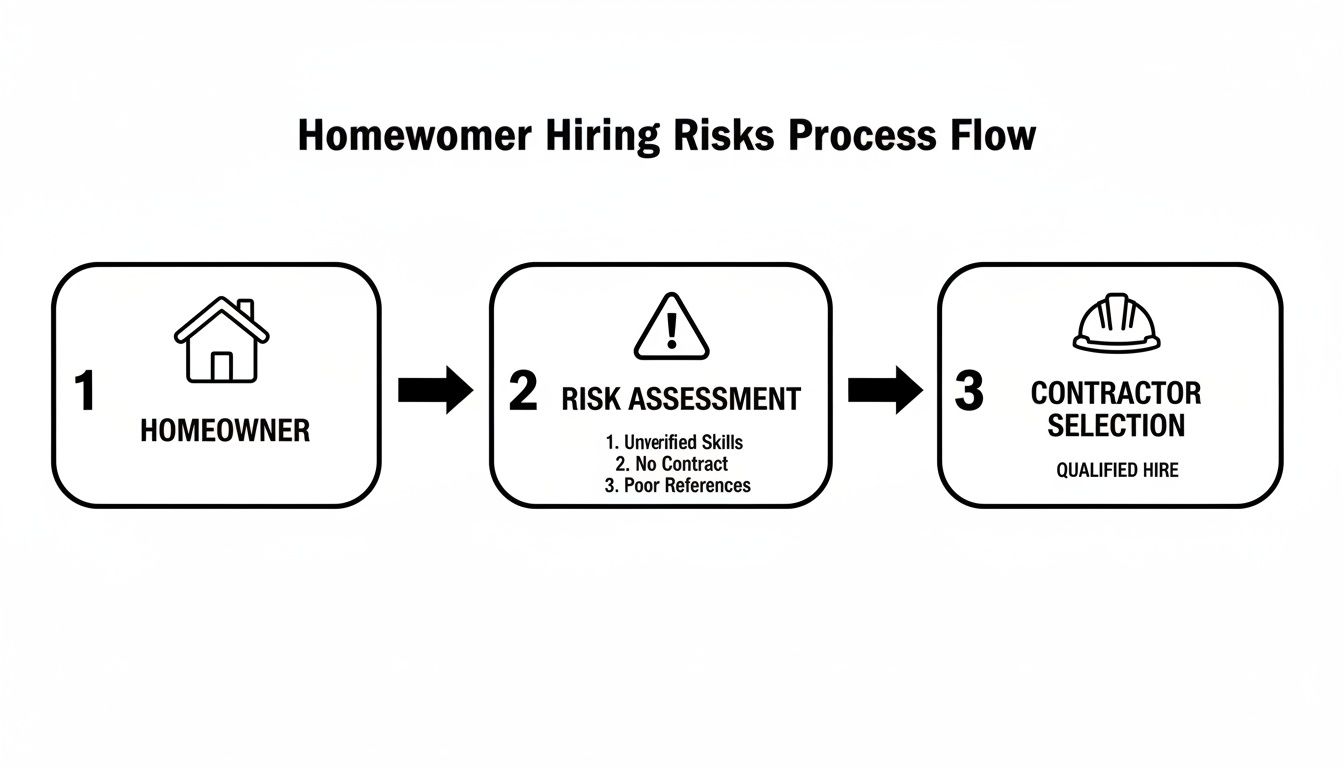
Skipping these initial checks on skills, contracts, and references puts you in the path of serious financial and safety risks before work even begins. Asking for a license number and proof of insurance upfront is a sign of an informed client. A true professional respects this diligence.
This simple verification process is your best defense. By taking these few minutes to confirm details, you ensure you’re only engaging with legitimate professionals who take compliance, safety, and quality craftsmanship seriously, like the team at Stonecap Masonry.
Asking the Right Questions to Find the Right Builder
You’ve done your homework and confirmed their license and insurance online. Now comes the real test: the interview. This is your chance to gauge their expertise, professionalism, and understanding of the unique challenges of building on the Central Coast.
With enforcement stings becoming more common across Monterey County, homeowners have every right to be cautious. Asking sharp, specific questions tells a contractor you’re an informed client who won’t settle for subpar work or vague answers.
Questions That Reveal True Local Expertise
Generic questions get you generic answers. To find out if a builder can handle your project, get specific about local conditions. A seasoned Monterey Bay pro will have confident, detailed answers.
Here are a few questions to start with:
- "Can you walk me through your base preparation for a patio, knowing we have heavy clay soil here?" Their answer should immediately get into proper compaction, the type of base rock they use, and drainage solutions. Anything less is a warning sign.
- "How do you handle the permitting for a new retaining wall in Monterey County?" A good response shows they know the local planning departments and when a project requires a structural engineer.
- "What happens if you find something unexpected, and how do you communicate that?" This reveals their communication process. You’re listening for a clear system involving written change orders so you’re never blindsided by a surprise bill.
A contractor's ability to clearly explain their methods for dealing with coastal weather, expansive soils, and local permits reflects their hands-on experience in our community.
The Power of Community Recommendations
Your interview is just one piece of the puzzle. Tapping into the local network is also critical. Don't underestimate platforms like Nextdoor or local Facebook groups for places like Pacific Grove and Carmel. Neighbors are often brutally honest and will share both glowing reviews and horror stories.
When you ask for references, request recent, similar projects nearby. Seeing craftsmanship firsthand in our portfolio of completed work is a great start, but hearing directly from a neighbor about their experience is invaluable. This blend of professional vetting and community feedback is your best defense as central coast licensing rules are tightening—how homeowners should hire in 2026 becomes more critical.
Decoding the Contract: Your Ultimate Protection
A well-written contract is the single most important document protecting you and your home. It's the legally binding blueprint for your entire project, laying out responsibilities, timelines, and costs to prevent surprises. With tighter licensing enforcement coming in 2026, a detailed contract is your best defense.
Think of it as the structural foundation of your agreement. For homeowners in Monterey County, this document is what separates a smooth, professional project from a nightmare of ghosting contractors, ballooning costs, and shoddy work.

Key Components of a Compliant Contract
Every contract you sign needs to be crystal clear, specific, and compliant with California law. A trustworthy contractor will always provide a contract that spells everything out, including these essentials:
- Detailed Scope of Work: The contract must describe exactly what will be done. For a new stone wall in Salinas, it should specify dimensions, materials, reinforcement details, drainage systems, and site cleanup.
- Clear Payment Schedule: Payments should be tied directly to completed project milestones, not arbitrary dates. This ensures you only pay for finished work that meets your standards.
- Change Order Process: A proper contract outlines a formal, written process for handling any changes, so you must approve all additional costs before the work is done.
- Contractor's Information: The document must clearly list the contractor's full name, business address, and active CSLB license number.
A common red flag is a contractor demanding a huge cash down payment. California law limits down payments to $1,000 or 10% of the contract price, whichever is less. Any contractor asking for more is breaking the law.
New Compliance Rules Reinforce Contractor Accountability
Statewide, California is increasing its focus on contractor accountability. This trend toward greater transparency benefits all homeowners.
This increased scrutiny is another reason why a detailed contract is non-negotiable. It proves both you and your contractor are operating by the book. Whether you're planning simple repairs or intricate custom stone work, the contract is what protects your investment.
Payments, Permits, and Getting the Job Done Right
You’ve signed the contract and found a verified contractor. But how you manage the project from here is just as critical. Staying on top of the details is essential as Central Coast licensing rules are tightening—how homeowners should hire in 2026 becomes the new reality.
How to Handle Payments the Smart Way
A reputable contractor will never ask for a huge chunk of cash upfront. A legitimate contract will always tie payments to visible progress.
Your payment schedule should be based on completed milestones, for example:
- A deposit to start (10% or $1,000, whichever is less, as per state law).
- A payment after excavation and foundation prep is complete.
- Another payment once the core structure is built.
- The final payment only after cleanup and your final approval.
This approach keeps you in control and incentivizes the contractor to maintain progress.

Don't Skip the Permits or Project Paperwork
Permits are not just red tape; they are your assurance that the work is safe and up to code. Any significant structural work, like engineered retaining and garden walls on a Carmel Valley slope, requires a permit.
Your contractor should handle the entire permit process. It’s a huge red flag if they ask you to pull the permit yourself. Any deviation from the original plan must be documented with a written change order that details the new work, cost, and timeline adjustments.
The Final Walkthrough and Your Ultimate Protection: Lien Releases
When the project looks finished, it’s time for the final walkthrough. Walk the site with your contractor and create a "punch list"—a detailed list of any small fixes needed. Do not make the final payment until every item has been completed to your satisfaction.
Before you hand over that last check, there's one critical step: getting lien releases. You need a signed release from your general contractor and every subcontractor and major material supplier. This is your non-negotiable proof that everyone has been paid.
Without these releases, an unpaid supplier could place a mechanic's lien on your property, forcing you to pay them again. A true professional will have this paperwork ready, giving you final peace of mind.
Frequently Asked Questions About Hiring Contractors on the Central Coast
1. Why is a contractor's workers' comp insurance so important in 2026?
If a worker gets hurt on your property and their employer lacks workers' comp insurance, you could be held liable for their medical bills. The 2026 law makes this insurance mandatory for all licensees, shifting that risk away from the homeowner and onto the contractor.
2. What's the difference between a contractor being bonded vs. insured?
A contractor's bond is a type of surety bond that provides limited financial protection if they fail to complete a job or pay suppliers. Insurance, like general liability, covers accidental property damage, while workers' comp covers employee injuries.
3. How much can a contractor legally ask for as a down payment?
In California, the down payment for a home improvement project cannot exceed $1,000 or 10% of the total contract price, whichever amount is less. Any contractor demanding more is violating state law designed to protect consumers.
4. How can I verify a contractor's license?
You can instantly check a contractor's status using the free online search tool on the Contractors State License Board (CSLB) website. It shows if their license, bond, and workers' compensation insurance are active and in good standing.
5. Does my masonry project in Monterey County need a permit?
It depends on the scope, but many projects do, especially retaining walls over a certain height or patios affecting drainage. A licensed, local masonry contractor will know the specific requirements for Salinas, Carmel, or Monterey and handle the entire permitting process for you.
Hiring a contractor in 2026 requires more diligence, but these changes ultimately protect your investment. By verifying credentials and understanding the process, you can confidently hire a professional to bring your vision to life, ensuring it's built safely and correctly for our local Monterey County climate. For any project, always consult a licensed masonry professional.
