
Direct Answer: Saturated backfill with nowhere to drain builds hydrostatic pressure at the base of the wall. The wall rotates outward or slides at the footing, and that movement never reverses.
Most of the failed walls I get called out to look at did not fail during a storm. They failed over four or five winters, and the owner only noticed the year the top course finally leaned far enough that you could see it from the driveway.
That slow-motion part matters right now. NOAA is putting very high odds on a strong El Niño for the 2026-27 winter, and the walls in Monterey County that are going to struggle are the ones built without a drainage layer behind them.
I want to walk through what the forecast actually says, why our soil makes a wet winter harder on masonry than it sounds, and what happens inside a wall when water has nowhere to go. Not a prediction of floods. A look at how the odds moved and what that means for the wall in your backyard.
What the August NOAA Update Actually Says
The August 13, 2026 ENSO Diagnostic Discussion from NOAA’s Climate Prediction Center kept the alert system at El Niño Advisory and said the event is strengthening. Here is the short version of the numbers:
- Greater than 90% chance of a very strong event during fall and winter 2026-27
- 97% chance El Niño persists through early spring 2027
- Roughly a 69% chance the October through December window ranks as a historic event, meaning a three-month RONI of at least 2.5°C, which would put it among the strongest since 1950
- July index values came in at 1.4°C in Niño 3.4, 1.7°C in Niño 3, and 2.9°C in Niño 1+2
You can read the current discussion yourself on the NOAA Climate Prediction Center’s ENSO page.
Now the honest part. A strong El Niño shifts the odds toward above-normal precipitation and more frequent atmospheric rivers in California. It does not promise them. The 2015-16 El Niño was a monster on paper and underdelivered for much of the state because the storm track ran north of us.
So I am not telling you the Salinas Valley is going to flood. I am telling you the probability of a soaking winter went up, and a wall with no drainage is a wall that only survives dry years.
Why Monterey County Soil Turns a Wet Winter Into a Wall Problem
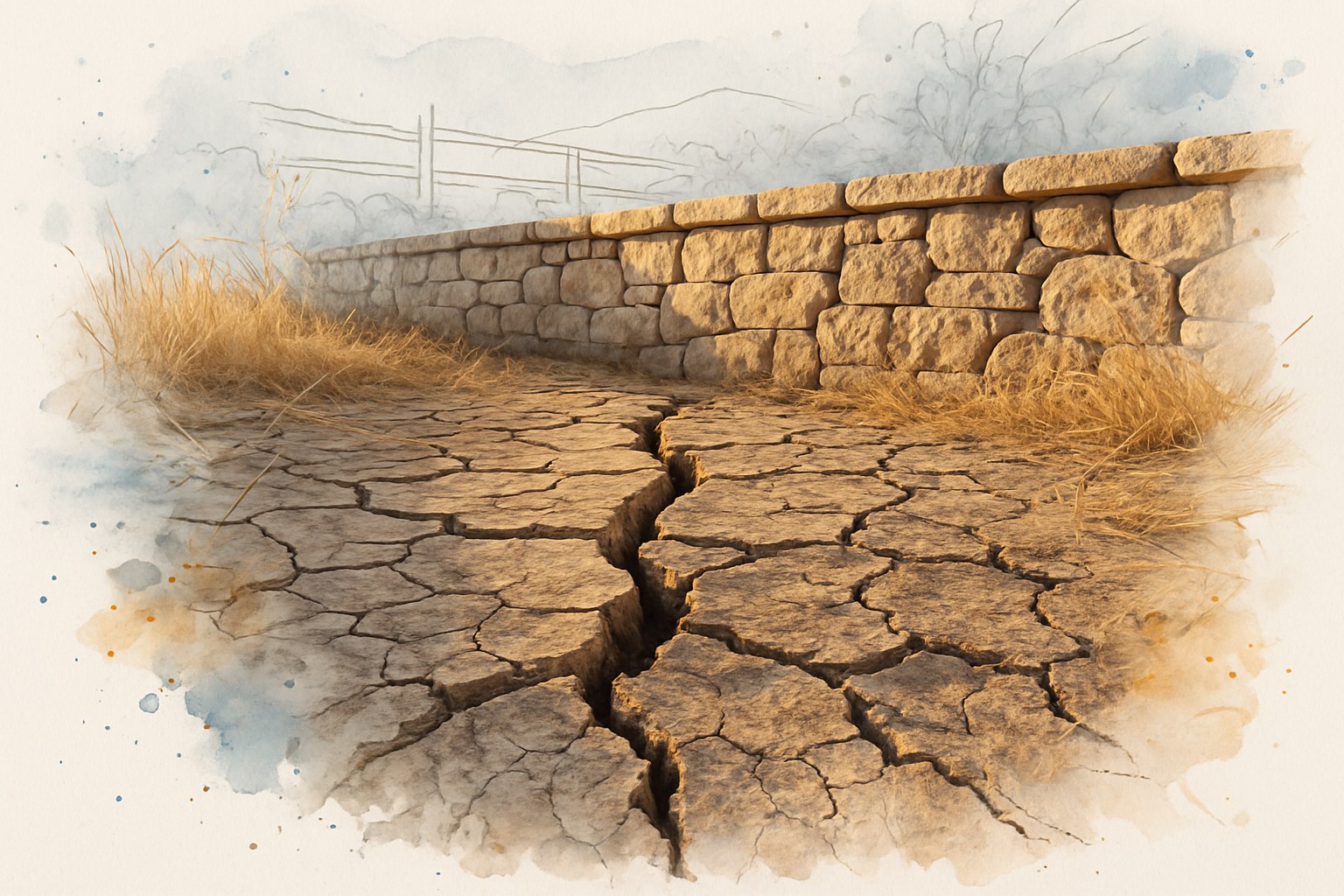
A lot of ground around Salinas, Carmel Valley, and the flats below the Highway 68 grade is clay-heavy. Clay does two things that fight masonry: it swells when it takes on water, and it shrinks when it dries out.
By late August, that soil has been shrinking for months. You can see the cracks in the ground. Some of them run several inches deep, and I have seen them open right up against the back of a wall.
Those cracks are the problem. They are preferential channels, meaning the first heavy rain does not soak in slowly and shed off the surface. It pours straight down those cracks and arrives at the back of your wall in minutes.
Expansive soil damage is worst in exactly this pattern:
- A long dry stretch that shrinks and cracks the soil
- A rapid, soil-saturating rain event
- Clay swelling as it rehydrates, pushing outward on whatever is in its way
- Repeat, several times, over one winter
A strong El Niño winter is a machine for producing that pattern. I went deeper on the soil side of this in what a strong El Niño winter actually does to masonry, and the drainage side is covered in the drainage layer a retaining wall cannot work without.
What Happens Inside the Wall, In Order
This is the sequence I explain to homeowners standing in their yard, because once you see it as a chain of events, the repair conversation makes a lot more sense.
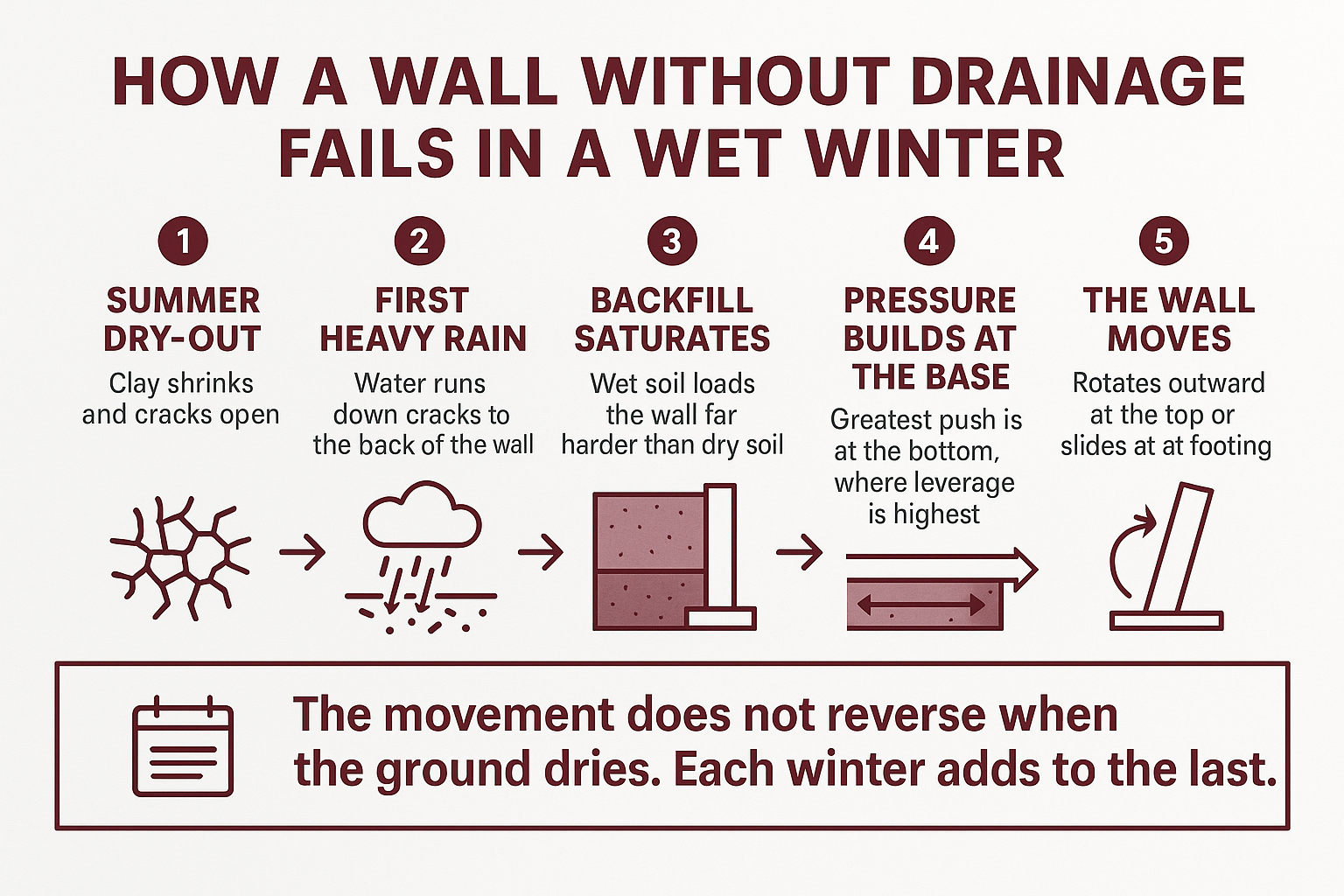
Step one: the backfill saturates. Dry soil is heavy. Saturated soil is much heavier, and it stops behaving like soil and starts behaving partly like a fluid. It loads the wall far harder than drained backfill ever does.
Step two: the water has no exit. If there is no gravel layer, no perforated pipe, and no working weep holes, the water sits. If the weeps exist but are packed with silt and root fiber, same result.
Step three: pressure builds at the base. Hydrostatic pressure increases with depth, so the heaviest push lands at the bottom of the wall. That is also where the leverage against the wall is greatest.
Step four: the wall moves. It either rotates outward at the top or slides forward at the footing. Sometimes both. On block walls you will often see a stair-step crack open at one end first.
Step five: it stays moved. This is the part people miss. When the ground dries out in April, the wall does not go back. Each wet season adds to the last.
That cumulative part is why a wall failure looks sudden and almost never is. It has been progressing for years, and the winter people blame is just the one that pushed it past the point of noticing.
Reading What a Wall Is Telling You Before Winter
These are the signs I look for on a walkthrough, and roughly how I weigh each one. Every wall is different, so treat this as a starting point rather than a diagnosis.
| What You See | What It Usually Means | How Fast It Needs Attention |
|---|---|---|
| Top course leaning out past the base | Rotation from pressure behind the wall | Before the first heavy rain |
| Stair-step cracking through block joints | Differential movement or footing issue | Before the first heavy rain |
| White chalky staining on the face | Water is moving through the wall, not around it | This season |
| Dry weep holes during a storm | Weeps are clogged or drainage was never installed | This season |
| Soil bulging or slumping above the wall | Backfill is moving, wall is losing the fight | Right away |
| Standing water at the base after rain | No outlet, water is sitting against the footing | This season |
The Failure Sequence, Start to Finish
Here is the whole chain in one view, from a dry August yard to a wall that has permanently moved.
Why an October Look Beats a March Look
By March, the movement has already happened. You are pricing a rebuild instead of a retrofit.
In October, the ground is still dry enough to excavate cleanly, the soil is easy to cut, and the wall has not been loaded yet. That is the cheap window, and it closes when the rain starts.
Here is what I actually check on a pre-winter walkthrough:
- Whether weep holes exist, and whether anything comes out of them
- Whether there is a gravel layer behind the wall or just packed native clay
- Where the surface water above the wall goes during a storm
- Whether the footing depth looks appropriate for the wall height and slope
- Whether the top course has moved relative to the base
On cost, I will not throw a number at you, because the spread is enormous. A wall that needs weeps cleared and a surface swale cut above it is a different job from one that needs the backfill excavated and a full drain system installed. What drives the price is wall height, length, access for equipment, how much soil has to come out and go somewhere, and whether the footing is sound underneath it all.
Access is the sleeper cost on the Peninsula. A wall behind a tight Pacific Grove lot line or down a steep Carmel Valley slope can double the labor compared to the same wall with truck access. Get a site-specific quote rather than trusting a per-foot number you found online.
If you are already seeing a lean, read when does a leaning retaining wall become an urgent problem before you decide it can wait another season. And if you are not sure whether the movement you are seeing counts, the field signs are broken down in warning signs your retaining wall is under more stress than it looks.
Frequently Asked Questions About El Niño and Retaining Walls
Does a strong El Niño guarantee a wet winter in Monterey County?
No. It shifts the odds toward above-normal rain and more atmospheric rivers, but the storm track still decides. The 2015-16 El Niño was very strong and much of California stayed drier than expected because the track ran north. Plan around a raised probability, not a certainty.
My wall has weep holes. Am I covered?
Only if they work. I clear plenty of weeps that are packed solid with silt, root hair, or landscape fabric that got installed wrong. Run a hose behind the wall and see if anything comes out the front. If nothing does, the weeps are decorative.
Can drainage be added to an existing wall, or does it have to come down?
It depends on how far the wall has already moved. If it is still plumb and the footing is sound, excavating the back, adding a gravel layer and a perforated drain, then backfilling is often workable. Once a wall has rotated significantly, you are usually rebuilding, because the movement does not come back out of it.
Should I do the drainage work myself?
Surface work like clearing a swale or keeping weeps open is reasonable homeowner maintenance. Excavating behind a loaded retaining wall is not. You are removing the material that is currently holding the wall in place, and an open trench next to a leaning wall is a genuine safety hazard. That one belongs to a licensed contractor.
How do I confirm a contractor is licensed for this work?
Retaining wall construction falls under California’s C-29 masonry classification. Any homeowner can look up a license number free through the CSLB’s check-a-license tool and confirm it is active, bonded, and insured before work starts. Ask for the number in writing.
Thinking About Your Wall Before the Rain Starts?
If you have a wall in Salinas, Carmel Valley, Pebble Beach, or anywhere on the Monterey Peninsula that leans a little more each year, the dry-ground months are the easiest time to find out why. Stonecap Masonry keeps a walkthrough schedule through the fall for homeowners who want a straight read on what they are looking at. Reach the team at 831-262-0442 or at stonecapmasonry.com when you are ready to talk it through.
