
Direct Answer: Masonry repair cost is driven less by materials than by hidden scope, site access, mortar matching, and how much inspection the job needs. Two bids differ because each mason assumed a different scope.
You had two masons look at the same crumbling wall. One quoted a few thousand. The other quoted three times that. And nothing about the wall changed between visits.
I get this question constantly from homeowners in Carmel, Pacific Grove, and Salinas. It feels like one of us is wrong. Usually neither of us is wrong, we just priced two different jobs because we made different assumptions about what is happening behind the wall face.
This article covers the cost drivers that never show up in a photo: hidden scope, site access, mortar matching, and inspection. If you understand those four, a repair bid stops looking like a mystery.
Why Masonry Repair Cost Drivers Are Mostly Invisible
Materials are the smallest part of most repair bids. Stone, brick, block, and mortar are priced by the pallet and the bag, and any mason in Monterey County pays roughly the same for them.
What moves the number is labor hours, and labor hours are driven by conditions nobody can see from the driveway.
Here is what actually swings a repair price:
- How far the damage goes past what is visible on the surface
- Access to the work area, including whether a truck or wheelbarrow can reach it
- Whether the mortar needs to be color matched to existing work
- How much of the surrounding structure needs inspection before and after
- Demolition and disposal, which on old walls can take longer than the rebuild
A mason who assumes a small localized fix will quote low. A mason who assumes the visible damage is a symptom will quote higher, and build in time to find out.
That gap is the same reason two masonry bids for the same job can land thousands apart. The wall is identical. The assumed scope is not.
The Diagnosis Is the Job (And Skipping It Is Why Bids Are Wrong)
Crumbling mortar around a few bricks can mean one of two very different things.
It can be a localized repointing job, where old mortar has weathered out and new mortar goes back in. That is straightforward work with a predictable price.
Or it can be the surface sign of something structural:
- A failed drainage layer behind a retaining wall, pushing water through the joints
- A shifted or undersized footing that has moved the wall out of plane
- Water damage to the substrate behind a veneer face
- Corroded ties or anchors that no longer hold the face to the backing
You cannot tell which from a photo. I have to probe joints, check the wall for plumb, look at what is above and below the damage, and sometimes open a small test area to see the backing.
That step takes time, and it is the step that determines the real scope. A bid handed to you without it is a guess dressed up as a number.
This is also the line between a cosmetic patch and a real fix. I wrote more about the difference between a cosmetic fix and a masonry repair, because patching over a moving wall just hides the problem for a season.
Access: The Cost Factor Homeowners Overlook Every Time
This is the one that surprises people most. Where the wall sits changes the price of the exact same repair.
A chimney repair on a flat lot in north Salinas means a truck at the curb, a short ladder or a small scaffold, and material a few steps from the work.
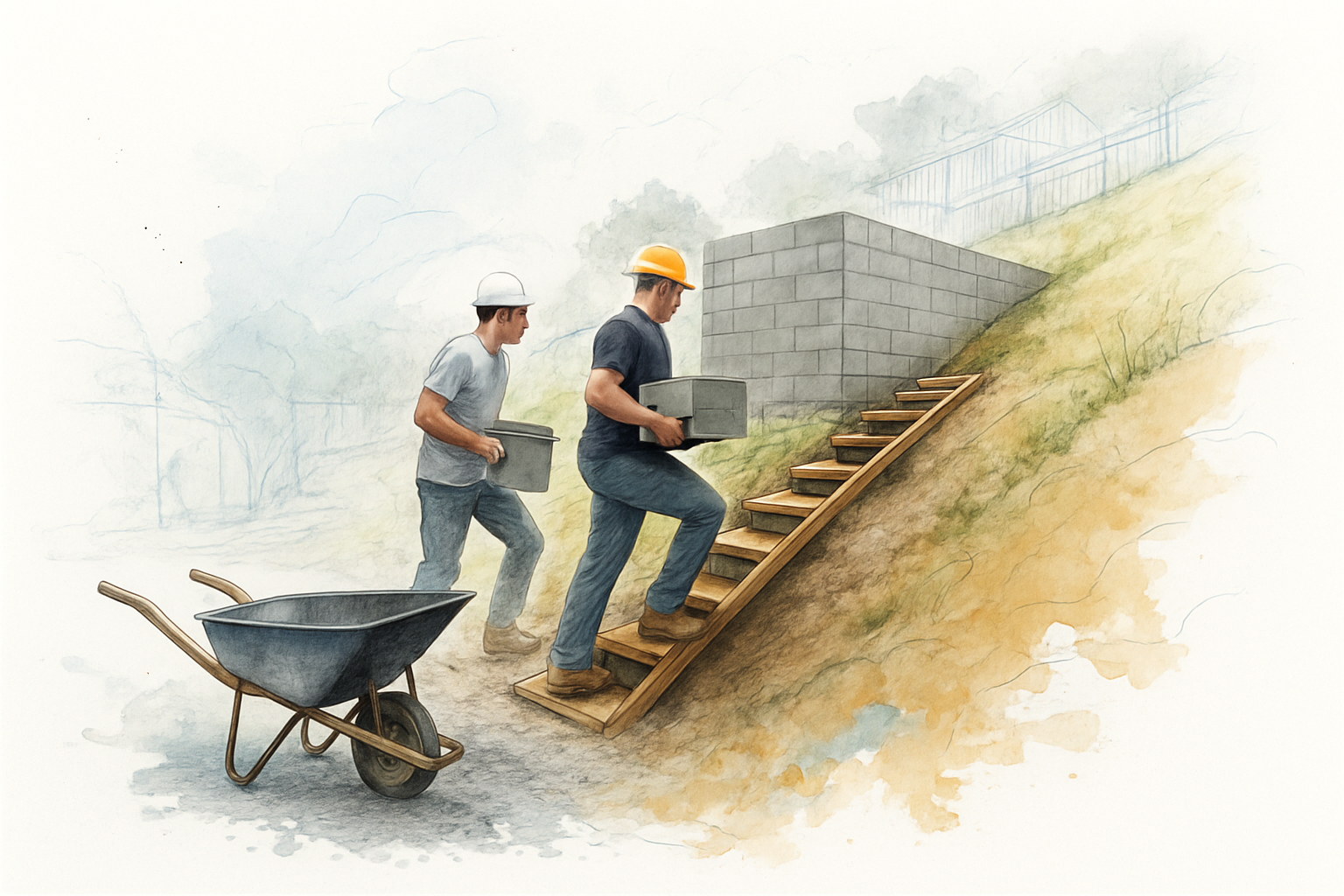
The same chimney repair on a Carmel hillside property means scaffold setup on uneven ground, longer setup and teardown, and sometimes a crew member doing nothing but moving material. That is real labor, billed by the hour, before a single joint gets cut.
Access problems I run into around the Peninsula:
- Narrow lots and tight side yards in Pacific Grove where a wheelbarrow barely fits
- Steep slopes in Carmel Valley where block gets carried by hand, course by course
- Mature landscaping and hardscape that has to be protected or worked around
- Gated communities with delivery windows and staging limits
- Backyard-only access through a house or a single side gate
Hand carrying material can easily double the labor hours on the delivery and demo phases alone. That is not padding, that is the job.
And it is exactly why I will not price a repair from photos. A site visit is not a sales tactic, it is the only way to count the hours honestly.
What Changes the Price by Repair Type
Different repairs have different hidden variables. Here is what I am actually looking for on each one.
| Repair Type | What You Can See | What Usually Drives the Cost |
|---|---|---|
| Crack repair | A visible crack line | Whether it is stable or still moving, and what caused it |
| Repointing | Crumbling, recessed mortar joints | Joint depth, mortar color match, and total linear footage |
| Stone or brick veneer | Loose or fallen stones | Condition of the substrate and anchors behind the face |
| Retaining wall | Bulging, leaning, or cracked courses | Drainage behind the wall, footing condition, slope access |
| Chimney | Spalling brick or open joints | Scaffold requirements, height, and roof pitch |
Mortar Matching Is a Real Line Item, Not a Detail
On a natural stone wall in Pebble Beach or a brick facade in Pacific Grove, a repair that does not match reads like a scar. You will see it every time you pull into the driveway.
Matching old mortar takes work. Color, sand type, and texture all shifted as the original mortar cured and weathered for decades.
Getting close usually means:
- Sourcing a custom blend to approximate the original sand and pigment
- Mixing test batches that have to cure before you can honestly compare them
- Tooling the joint to match the original profile, not just filling it
Curing time matters here. Wet mortar and cured mortar are different colors, so a same-day “match” is not a match at all.
Some contractors price this process separately. Some skip it entirely and hand you a repair that is structurally fine and visually obvious. Ask which one you are getting, because a low bid on a visible wall often means the match was left out.
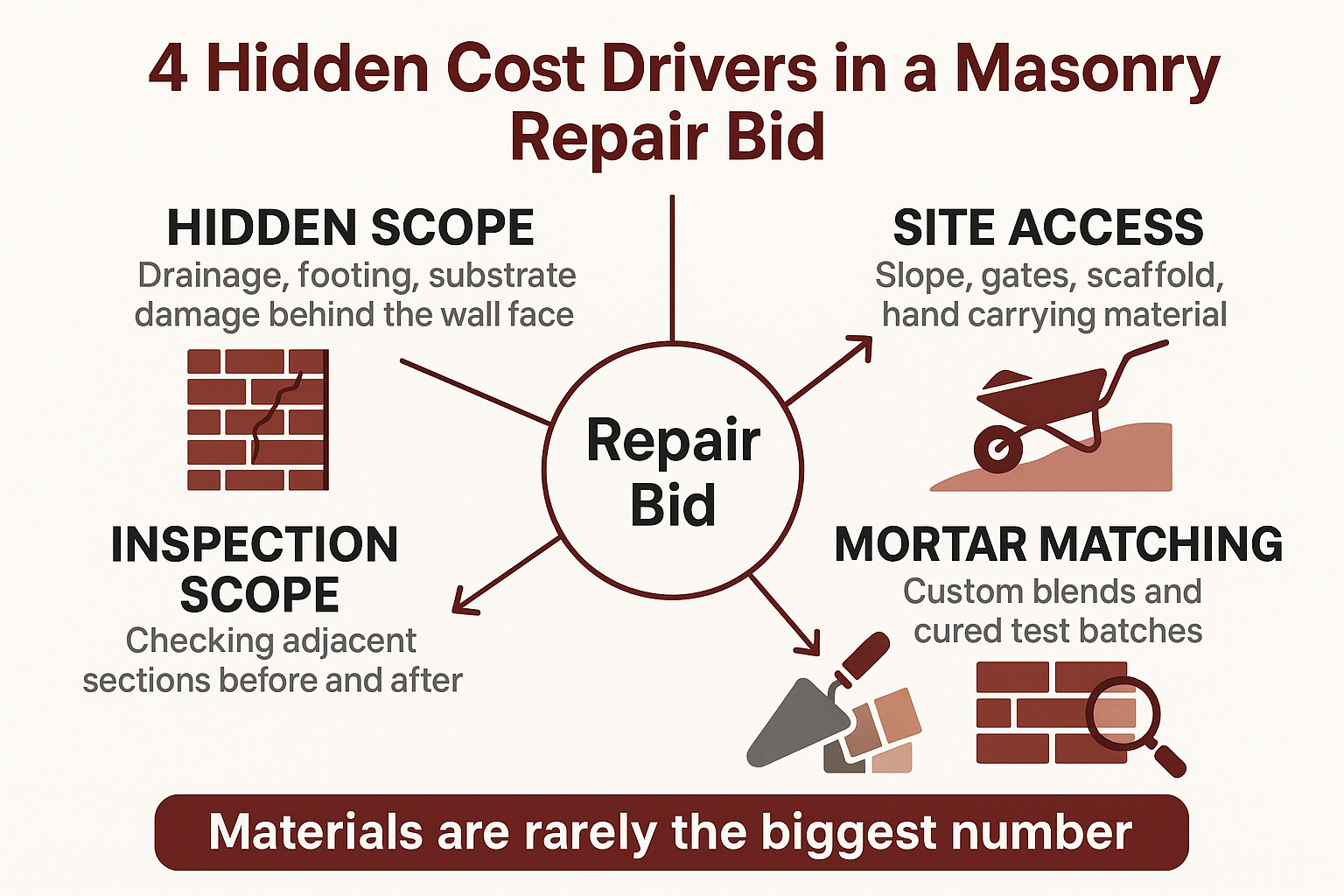
The Four Cost Drivers Behind Every Repair Bid
This breaks down where the money in a masonry repair quote actually goes, and why two bids can look so different.
Paying for Inspection Is Protection, Not Markup
One homeowner near the coast reached out after a utility vehicle clipped the corner column of a block retaining wall. Blocks were cracked and displaced, capstones were shifted, and debris sat at the base.
What stood out to me was the request. They did not just want the corner rebuilt. They wanted the adjacent wall sections checked for movement and for a base or footing issue.
That is exactly the right instinct. An impact that moves one column can loosen the tie-in on the courses next to it, and that damage is not always visible until you check the wall for plumb and probe the joints.
A responsible repair proposal should include:
- Inspection of the sections next to the damage, not just the damaged area
- A look at drainage and base conditions where the wall meets grade
- A final walkthrough after the work to confirm the tie-in and the top course sit right
When you see inspection time in a bid, that is a mason telling you what they plan to look at. A bid without it is quieter, and cheaper, and less useful. Retaining walls in particular deserve this attention, since several warning signs mean a wall needs a mason rather than a patch.
One Note for Commercial Property Owners in Monterey
If you manage an older masonry building, a repair inquiry can turn into something larger fast.
The City of Monterey has an unreinforced masonry hazard-reduction framework, and visible defects like a listing wall or a large crack can trigger a requirement for professional structural analysis that goes well beyond a standard repair quote.
Requirements vary by jurisdiction, building type, and age, so the local building department is the first call, not the last. But it is worth knowing before you budget a repair as a simple line item. There is more on this in what commercial property owners get wrong about masonry maintenance.
Frequently Asked Questions About Masonry Repair Cost Drivers
Why won’t you quote a repair from photos I send?
Photos show the surface, and the surface rarely tells the whole story. I cannot check a wall for plumb, probe joint depth, look at drainage, or judge access from an image. Any number I gave you would be a guess, and guesses turn into change orders.
What does a typical masonry repair cost in Monterey County?
Prices vary widely and I would not trust anyone who gives you a firm number sight unseen. In general market terms, small localized crack and joint repairs tend to land far below a partial wall rebuild, and a rebuild on a steep or hard to reach site can run several times the cost of the same work on a flat lot. An on-site visit is the only way to get an accurate figure.
Is the lowest bid always cutting corners?
Not always. Sometimes a low bid simply reflects a smaller assumed scope. Ask each contractor what they inspected, whether mortar matching is included, and what happens if they open the wall and find more damage. The answers usually explain the gap.
How do I check that a masonry contractor is actually licensed?
Ask for the license number and look it up yourself through the CSLB check a license tool. Masonry falls under the C-29 classification in California. The lookup also shows bond and workers compensation status, which matters if someone gets hurt on your property.
Does a repair need a permit?
It depends on the jurisdiction, the type of work, and whether the wall is structural. Cosmetic repointing often does not, while rebuilding a structural wall or a tall retaining wall frequently does. Check with your local building department before work starts.
Trying to Make Sense of Two Repair Bids?
If you are comparing quotes on a wall, chimney, or patio somewhere on the Monterey Peninsula, the most useful thing you can do is understand what each mason assumed before they wrote the number. Stonecap Masonry works throughout Salinas, Carmel, Carmel Valley, Pebble Beach, and Pacific Grove, and the team is available at 831-262-0442 or stonecapmasonry.com if you want a look at what is actually going on with your masonry. CSLB License #1073620, C-29 masonry classification.
