
Direct Answer: Most retaining walls fail because water builds up behind them. A working wall needs a gravel drainage layer, filter fabric over that gravel, and weep holes near the base so water can escape.
Most of the failed retaining walls I look at in Monterey County were not built with bad stone or bad block. They were built without a working way for water to get out.
Water is heavier than people expect. After a wet stretch in Salinas or Carmel Valley, the soil behind a wall soaks up rain and starts pushing forward with real force. That force is called hydrostatic pressure, and it is what tips, cracks, and slides walls off their footings.
This article goes behind the wall face instead of in front of it. I want to walk you through the three parts of a drainage system, how footing depth ties into all of it, and the exact questions to ask a contractor before you sign anything.
Why retaining wall drainage failure beats the wall, not the other way around
A retaining wall holds back soil. That part is obvious. What is less obvious is that a saturated soil mass weighs far more and pushes far harder than the same soil dry.
When there is nowhere for that water to drain, it stacks up behind the wall and loads the whole back face. The wall does not get a break until the soil dries out, which on the Peninsula can take weeks after a heavy season.
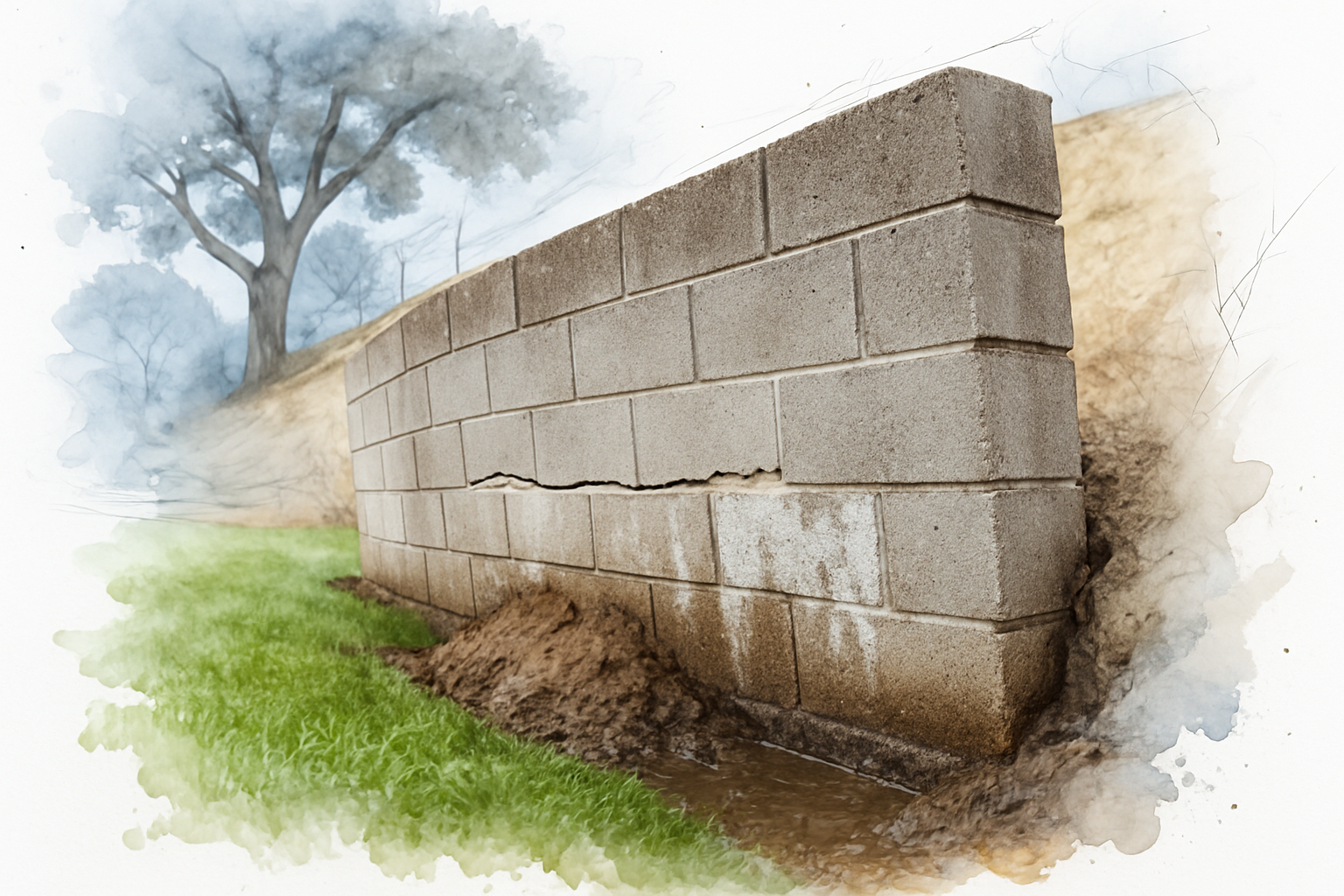
Here is what I see that pressure do, in rough order of how often:
- The wall leans out at the top while the base stays put
- Horizontal cracks open on the face, usually a third of the way up
- Block courses slide forward and lose their tie-in at corners
- Mortar joints crumble and stain from constant moisture
- Soil and mulch behind the wall settle into a low spot or sinkhole
One thing worth understanding: this is not always a slow decline. A wall can look fine for six seasons and then move an inch in one wet month once the soil behind it fully saturates. If you are already seeing movement, when a leaning retaining wall becomes an urgent problem is worth reading before the next storm cycle.
The three parts of a working drainage system
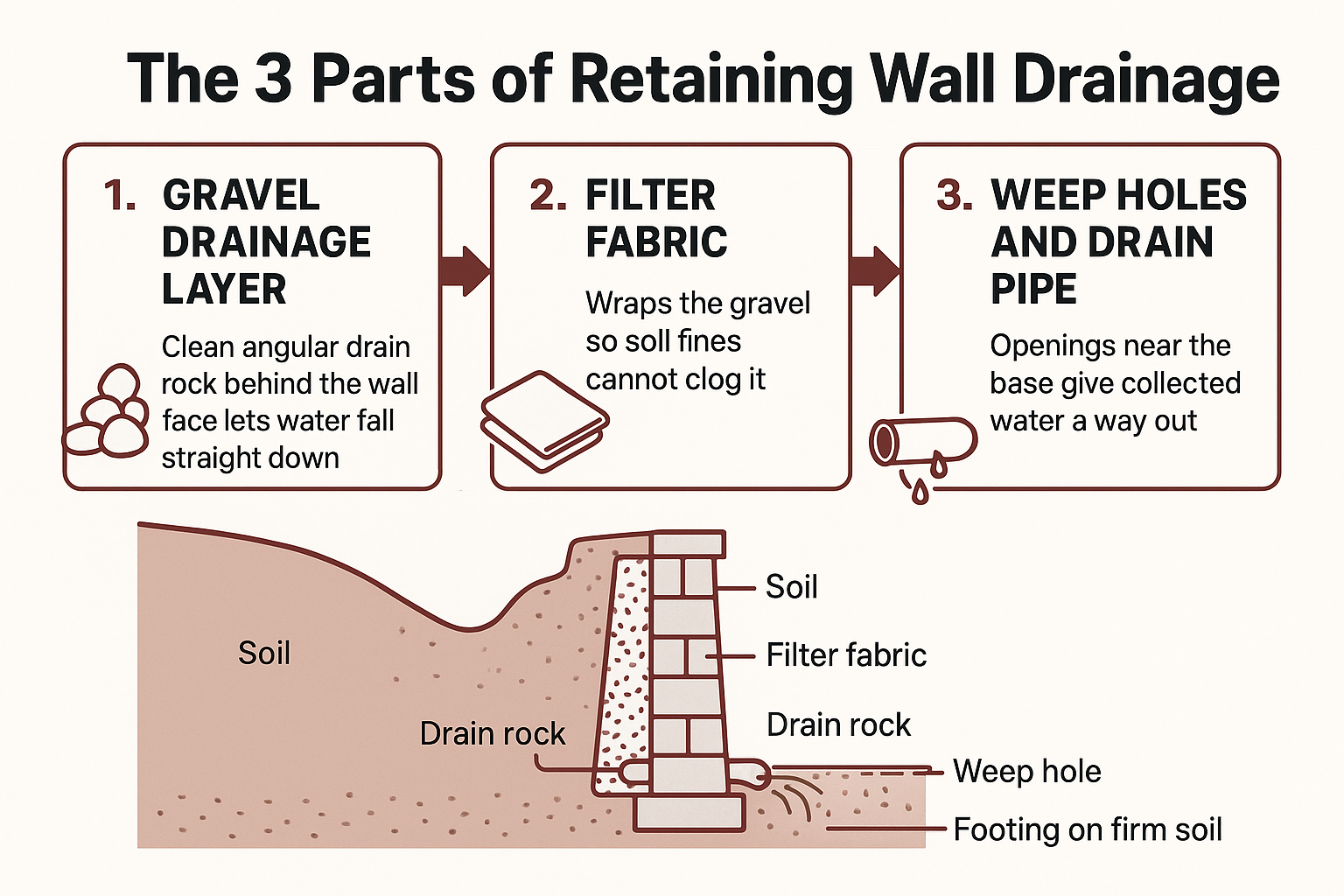
A drainage system is not one item on a bid. It is three pieces that only work together, and any one of them missing takes the whole thing offline.
1. The gravel drainage layer. This is clean, angular drain rock placed against the back of the wall, usually a foot or so thick and carried up most of the wall height. Water hits the gravel, drops straight down through the open spaces, and travels to the bottom instead of pressing on the block.
2. Filter fabric. Native soil wants to wash into that gravel and fill the gaps. Fabric wrapped around the gravel keeps the fines out so the rock stays open and permeable for decades instead of a few seasons.
3. Weep holes or a drain pipe with an outlet. Water at the bottom of the gravel needs a door. Weep holes are openings through the wall near the base at regular spacing, often paired with a perforated pipe set in the gravel and sloped to daylight.
Skip the fabric and the gravel silts up. Skip the weep holes and the gravel becomes a bathtub. Skip the gravel and there is nothing to move water anywhere at all.
When you get a bid, ask about each one by name. A contractor who answers all three specifically, including the spacing and where the water exits on your property, has built this before.
How the drainage system works, layer by layer
This is the same system laid out visually, from the soil side to the outlet.
The footing question nobody asks, and why I always do
Drainage and footings are the same conversation. A footing sitting in soft, wet subsoil will move once the ground behind the wall saturates, no matter how good the stonework above it looks.
We are not fighting deep frost on the Peninsula the way builders do in cold states. What we fight here is seasonal groundwater and expansive clay, and those vary property to property in Salinas more than most homeowners realize.
So the footing depth and width has to follow the site, not a rule of thumb:
- Is the footing bearing on firm undisturbed soil or on old fill?
- Does groundwater rise into that zone in a wet winter?
- Does the clay on the property swell and shrink through the year?
- How tall is the wall and what is loading the slope above it?
Here is my honest filter for homeowners comparing bids. If nobody asks about your soil, your slope, or where water currently drains before quoting a wall over roughly three feet tall, that bid is a guess dressed up as a number. Taller walls and walls holding a driveway or structure often need an engineer’s design and a permit, and requirements vary by jurisdiction and project type, so the local planning or building department is the place to confirm your specific case.
What the symptom usually tells you about the drainage
This is the shorthand I use on a first walk-through. It is a starting read, not a diagnosis.
| What you see | Likely drainage cause | What it usually means for repair |
|---|---|---|
| Top of wall leaning out, base in place | Pressure building with no outlet | Wall likely needs rebuilding with a full drainage layer |
| Horizontal crack across the face | Sustained lateral load from saturated soil | Structural assessment before any patching |
| Weep holes dry after heavy rain | Gravel clogged or fabric missing | Excavation behind the wall to restore drainage |
| Water seeping through joints and staining | Water finding its own path out | Drainage correction, not just joint repair |
| Soil settling or sinking behind the wall | Fines washing into the gravel | Backfill and fabric replacement |
| Blocks displaced at a corner | Impact, sometimes with a weak base underneath | Rebuild plus a check of footing and drainage |
Impact damage is often how a drainage problem gets discovered
A homeowner near Moss Landing reached out after a utility vehicle clipped the corner of a block retaining wall. Blocks were cracked and pushed out of line, a capstone had shifted and was partly unsupported, and debris was sitting at the base.
What stood out to me was the request that came with it. They asked that someone inspect the surrounding courses to see whether there was additional movement or a base and footing issue.
That instinct is right. A wall that gives up a whole corner to a bump sometimes tells you the base was already compromised, and rebuilding the visible damage without looking at the drainage behind it just resets the clock on the same failure.
So any structural repair I look at includes questions about what is behind the face:
- Is there gravel back there at all, and is it still open?
- Do the weep holes flow, or are they packed with soil?
- Is the footing continuous and bearing on solid ground?
- Are the adjacent courses tied in, or just leaning on each other?
This is also why I steer people away from patch work on structural walls. If you want the longer version of that reasoning, read the real difference between cosmetic damage and structural failure.
What drainage adds to the budget, and what skipping it costs
Drain rock, fabric, pipe, and the extra excavation and labor to place it all correctly are real line items. Costs move with wall height, access, haul-off, and soil, so treat any number you see online as context and not a quote.
But the ratio is what matters. Doing drainage right is a modest share of the original build cost, while rebuilding a failed wall means demolition, disposal, new material, and new footing, which routinely runs well past the price of the first wall.
That gap is why a low bid on a retaining wall deserves a hard look. When a number comes in noticeably under everyone else, the drainage layer is usually where the money was cut, and it is the one part you cannot inspect once the backfill goes in.
Before hiring anyone for structural masonry, confirm the license classification yourself through the state’s contractor license lookup at the CSLB. Retaining walls fall under masonry and concrete work, and one homeowner who contacted us specifically asked for license and insurance details up front. That is a smart ask, every time you hire.
Frequently Asked Questions About Retaining Wall Drainage
Can drainage be added to a retaining wall that was built without it?
Sometimes, but not cheaply. It means excavating the backfill behind the wall to place gravel and fabric, and coring weep holes through the face. If the wall has already moved or the footing is questionable, rebuilding often makes more sense than retrofitting a wall that is already compromised.
How far apart should weep holes be?
Spacing depends on wall height, length, and how much water the slope sheds, which is why I would rather look at your site than give a number here. What matters is that they exist at regular intervals near the base, that they connect to open gravel, and that water actually exits somewhere useful instead of onto your neighbor’s property.
My weep holes never drip, even after big storms. Is that good?
Usually it is the opposite of good. Dry weep holes after real rain generally mean they are plugged with soil or there is no functioning gravel behind them. Water is still back there, it just has no path.
Do garden walls need drainage too?
A low decorative wall that is not holding back a slope has different demands than a structural retaining wall. But anytime a wall retains soil, even at two feet, water behind it still needs somewhere to go. We build low walls to the same standard for that reason.
Does a retaining wall in Monterey County need a permit?
It depends on height, location, and what the wall is supporting, and requirements differ between jurisdictions like Salinas, Carmel, and unincorporated Monterey County. Taller walls and walls surcharged by a driveway or structure commonly trigger a permit and an engineered design. Confirm with your local building department before work starts.
Thinking through a retaining wall on the Peninsula?
If you are planning a new wall or watching an existing one start to move, the drainage behind it is the part worth understanding before anything gets backfilled. Our team works throughout Monterey County, CA, from Salinas out to Carmel Valley, Pebble Beach, and Pacific Grove, and we are glad to talk through soil, footings, and drainage on your specific site. Reach us at 831-262-0442 or stonecapmasonry.com when the timing suits you.
