
Direct Answer: When a retaining wall shows structural damage, shifted capstones, or base movement, a licensed masonry contractor is required — not a handyman. In California, permitted wall work must be pulled and inspected by a licensed contractor.
Most homeowners don’t call a masonry contractor the moment something goes wrong with a retaining wall. They call whoever is available — a handyman, a landscaper, a general laborer — and ask them to patch what they can see. I understand that instinct. The damage is visible, the fix seems obvious, and getting someone out fast feels like the right move.
But a retaining wall isn’t a fence post or a cracked walkway slab. It’s a structure that holds back soil, manages water pressure, and in Monterey County’s seismic environment, has to resist lateral forces that most people never think about until something fails. When that wall takes damage — from a vehicle strike, from seasonal soil movement, from years of moisture cycling in Salinas’s coastal climate — what you see on the surface is rarely the full picture.
This article is about how to read that situation correctly: what a proper inspection actually covers, why the finishing details matter more than they look, and when California licensing rules mean a handyman simply cannot legally do the job.
What a Real Site Evaluation Should Cover
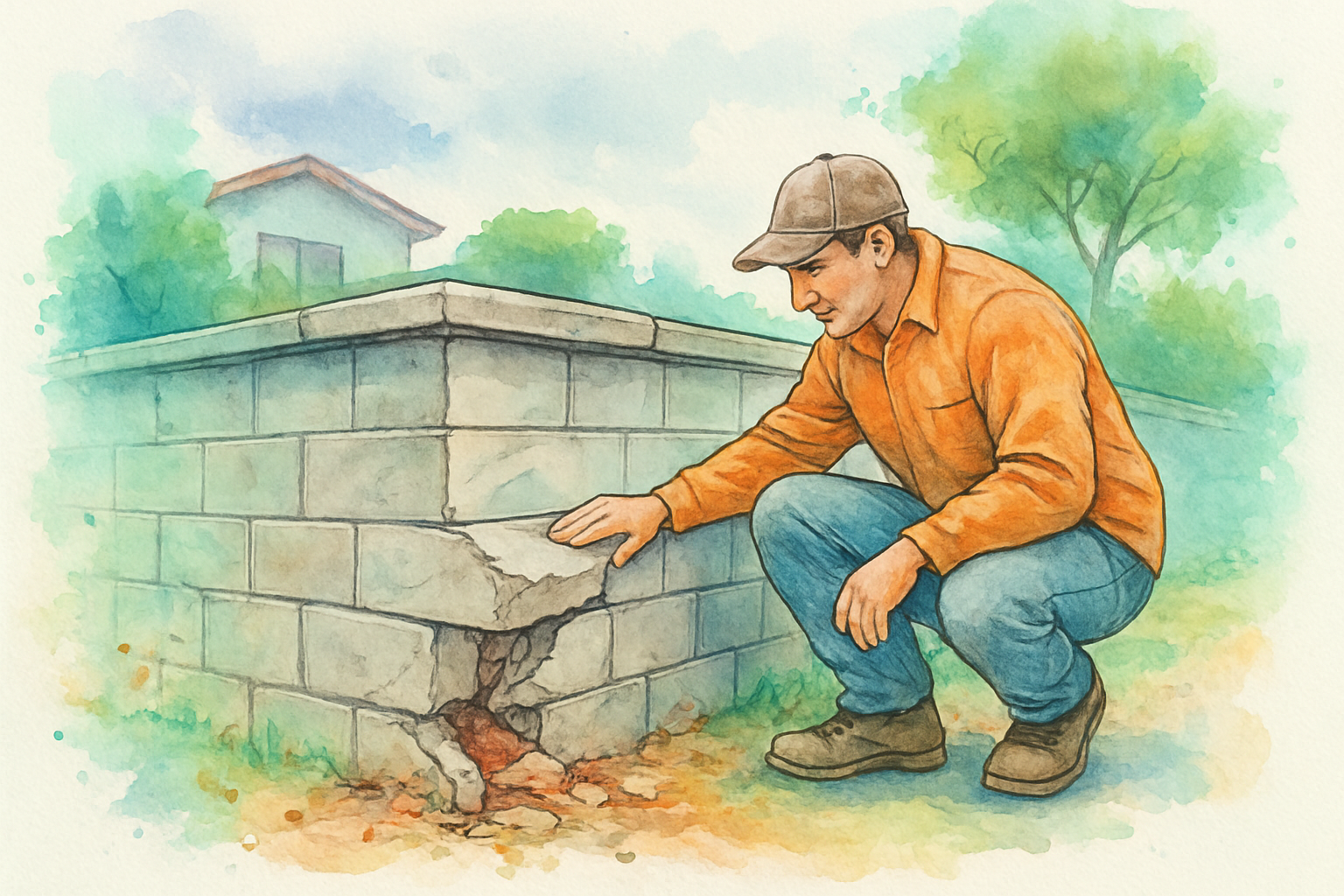
One inquiry we received recently described exactly the scenario I see more often than I’d like. A concrete block retaining wall at a Moss Landing property had been struck by a utility vehicle. Multiple segmental blocks at the corner column were cracked and displaced, the capstone was shifted and partially unsupported, and debris had collected at the base. The homeowner’s instinct was to get someone out to patch the corner.
That instinct isn’t wrong — but it’s incomplete. The smarter first step was asking for a full inspection of the adjacent wall sections before any rebuild started. And that matters enormously, because the visible damage is just the entry point.
A thorough site evaluation for a damaged retaining wall should include:
- Visual inspection of the damaged section — block displacement, cracking pattern, capstone condition
- Assessment of adjacent courses on both sides of the impact point, looking for hairline cracks, mortar joint separation, or any course that has shifted even slightly out of plane
- Footing and base examination — digging out or probing near the damaged area to check whether the footing has moved, heaved, or lost bearing
- Drainage review — looking for signs of soil saturation, erosion at the toe of the wall, or blocked weep holes that could be contributing to hydrostatic pressure
- Wall batter and plumb check — measuring whether the wall still holds its designed lean or has begun to rack
Properties in Salinas, Moss Landing, and Carmel Valley often sit on fill or in areas with variable moisture levels. A wall can look intact from ten feet away and still have base movement happening underneath. If whoever you bring out only looks at the broken corner and moves on, that’s an incomplete assessment — and you’ll likely be making that same call again in two or three seasons. For more on how to read what a wall is telling you, Warning Signs Your Retaining Wall Is Under More Stress Than It Looks walks through the indicators worth watching.
Why Capstone Damage Is Never Just Cosmetic
I want to spend some time on capstones specifically, because they get dismissed as a finishing detail when they’re actually doing real structural work.
A capstone that sits level, is properly bedded in mortar, and ties the top course together does several things at once. It sheds water away from the wall’s core. It locks the top course so it can’t rack or shift under lateral load. And in a seismic zone like Monterey County — which sits in a region with well-documented fault activity — a properly secured top course is part of what keeps the whole wall from behaving like a stack of loose blocks during ground movement.
When a capstone is struck, shifted, or left partially unsupported, here’s what actually starts to happen:
- Water infiltration — the gap between a displaced capstone and the course below it becomes an entry point. Water gets in, migrates through the block or mortar, and begins the freeze-thaw and moisture cycling process that cracks masonry from the inside.
- Top course instability — a capstone that isn’t bearing evenly puts uneven load on the blocks below it. Over time, that uneven load translates into cracking in the courses underneath.
- Reduced lateral resistance — in a seismic event, even minor, the top course of a wall is the first place you’ll see movement if it isn’t properly tied. A capstone that’s already shifted is already compromised.
The homeowner who described their Moss Landing wall specifically asked for the capstone to be reset and the top course realigned so it sits level and continuous. That’s exactly the right scope to request. It’s not a cosmetic upgrade — it’s part of what makes the rebuilt section structurally sound.
For context on how surface damage can mask deeper structural issues, The Real Difference Between a Cosmetic Fix and a Masonry Repair goes into this in more detail.
What Sets a Licensed Contractor Apart From a Handyman for Retaining Wall Work
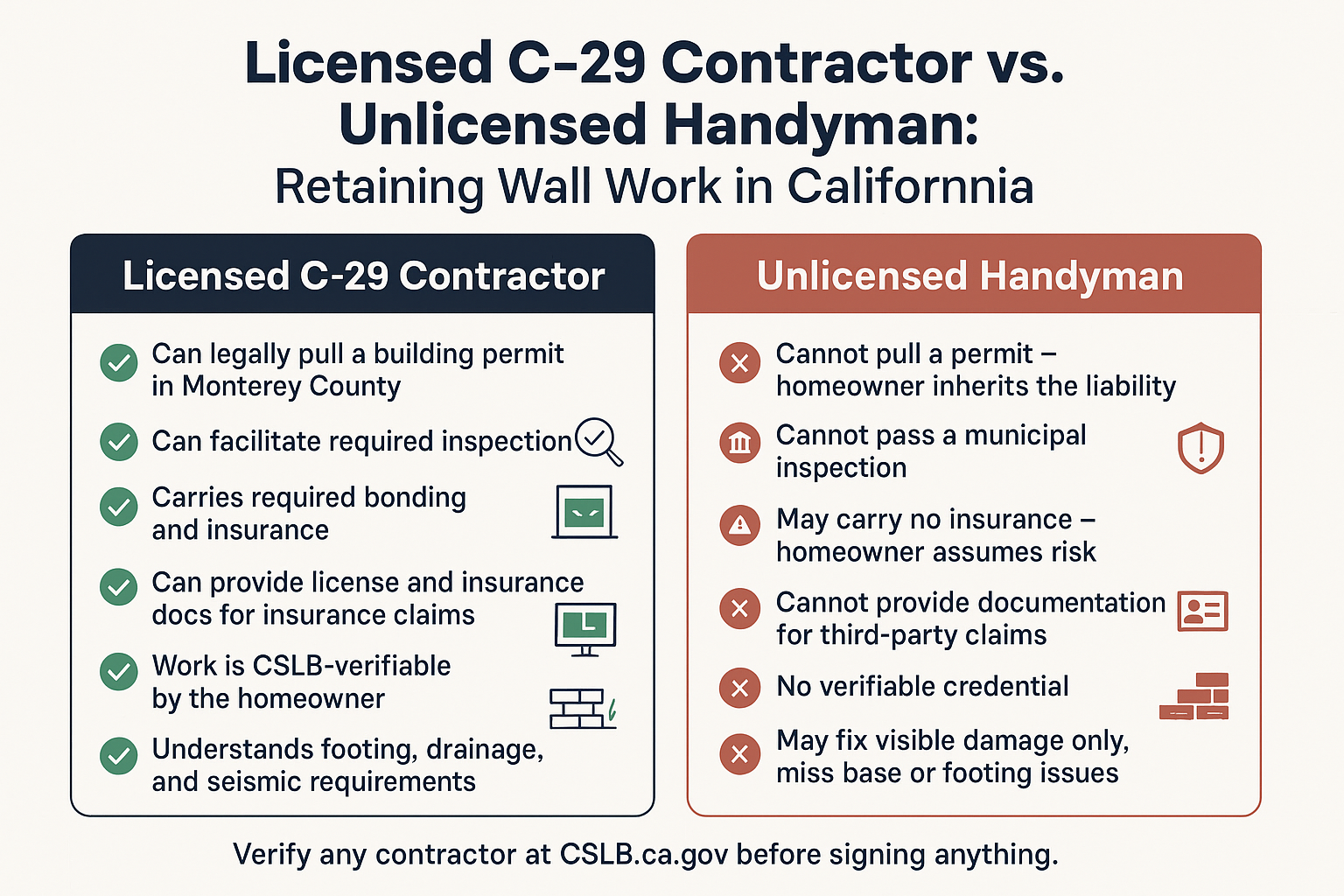
This comparison lays out the practical differences between a licensed C-29 masonry contractor and an unlicensed handyman when it comes to permitted retaining wall work in California.
The Permit and Licensing Reality in Monterey County
This is where I see homeowners get burned most often, and it’s worth being direct about it.
In most Monterey Peninsula jurisdictions, retaining walls above a certain height — commonly four feet measured from the bottom of the footing — require a building permit before work begins. The specific threshold varies by city and county, and some jurisdictions have additional requirements for walls near property lines or in areas with known soil movement. But the general principle holds: permitted work requires a licensed contractor.
Here’s what that means practically. An unlicensed operator can pour a footing and stack blocks. There’s nothing stopping them from doing the physical labor. But they cannot legally pull a permit in California, and they cannot facilitate the inspections that come with a permitted project. If the work is done without a permit when one was required, the homeowner owns that problem — including the cost of rework if a future sale, refinance, or insurance claim surfaces the unpermitted structure.
California’s C-29 masonry contractor license is the classification that covers the full scope of wall construction and repair work that triggers these requirements. When you’re comparing bids for a retaining wall project, verifying the contractor’s CSLB license through the CSLB’s check-a-license tool takes about 90 seconds and tells you whether the license is active, bonded, and insured.
There’s also a third-party liability angle worth mentioning. The homeowner in the Moss Landing situation I described earlier specifically asked the contractor to confirm license and insurance information before work began — because the damage was caused by another party and the repair cost would be reimbursed through that party’s insurance. A licensed, bonded, and insured contractor can provide that documentation immediately. Without it, the homeowner may not be able to get the work covered at all, regardless of who caused the damage.
If you want to understand how these same licensing and structural issues play out in commercial masonry contexts, How Seismic Risk Changes the Way Commercial Masonry Should Be Built covers that territory.
Retaining Wall Repair Scenarios: Who Should Handle It
Not every wall situation is the same. Here’s a rough breakdown of common retaining wall conditions and the appropriate level of response.
| Wall Condition | Appropriate Response | Licensed Contractor Required? |
|---|---|---|
| Single cracked block, no movement, wall under 3 feet | Minor masonry repair, monitor for expansion | Recommended — verify scope first |
| Shifted or partially unsupported capstone | Full top-course assessment and reset | Yes — structural implications |
| Corner section struck by vehicle, blocks displaced | Full inspection of adjacent sections + permitted rebuild | Yes — permit likely required |
| Wall leaning more than 1 inch out of plumb | Urgent structural assessment | Yes — do not delay |
| Base erosion or footing exposure visible | Excavation, drainage review, footing repair or replacement | Yes — permit likely required |
| Wall over 4 feet, any significant damage | Engineering review + licensed contractor rebuild | Yes — always |
What Retaining Wall Repair Actually Costs in the Salinas Area
I get this question on almost every site visit, and I’d rather give you a real answer than a vague one.
Retaining wall repair costs vary based on a handful of factors that genuinely matter:
- Extent of damage — a single shifted capstone is a different scope than rebuilding a full corner column from the footing up
- Wall height and length — taller walls require more material, more labor, and often engineer review
- Access — properties in Carmel Valley or hillside Salinas neighborhoods can add time if equipment access is limited
- Material match — matching existing concrete block, natural stone, or segmental retaining wall units to what’s already there affects both material cost and labor time
- Permit requirements — when a permit is required, add inspection fees, processing time, and the cost of any additional documentation
- Drainage corrections — if the inspection reveals a drainage issue that contributed to the damage, addressing it properly adds scope but prevents repeat failure
For a straightforward repair — say, rebuilding a damaged corner column, resetting capstones, and confirming adjacent course stability on a standard residential CMU wall — many Monterey County homeowners are looking at somewhere in the range of a few thousand dollars, depending on those variables. A larger repair involving footing work, drainage correction, or significant linear footage can run considerably higher.
I won’t put a firm number on it here because the gap between a minor patch and a full permitted rebuild is real, and I’ve seen walls that looked like one and turned out to be the other. The only accurate number comes from a site visit. For related reading on what drives cost differences between masonry bids, When Does a Leaning Retaining Wall Become an Urgent Problem? explains how severity affects scope.
Frequently Asked Questions About Retaining Wall Repair in Monterey County
How do I know if my retaining wall repair needs a permit in Salinas or Monterey County?
The general rule in most Monterey Peninsula jurisdictions is that walls four feet or taller (measured from the bottom of the footing) require a building permit. Some cities have lower thresholds or additional requirements for walls near property lines. The safest move is to call the relevant building department — City of Salinas, City of Monterey, or Monterey County — before work starts. A licensed contractor should be able to help you determine whether your specific project requires a permit.
Can a handyman legally repair my retaining wall?
For minor cosmetic work on a small, unpermitted wall, there’s no law stopping someone from doing the labor. But if the repair requires a permit — which most damage repairs on walls over four feet do — an unlicensed operator cannot legally pull that permit or facilitate the required inspections. You’d own the liability for unpermitted work, including potential rework costs.
A vehicle hit my retaining wall and the other party’s insurance will cover it. Does my contractor need to be licensed?
Yes, and this is actually one of the clearest illustrations of why licensing matters beyond job quality. A licensed, bonded, and insured contractor can provide documentation immediately that most insurance claims require before approving work. Without that documentation, you may not be able to get the repair covered — regardless of fault. Confirm license and insurance information before you sign anything.
My wall looks fine except for the damaged corner. Do I really need someone to inspect the whole wall?
I’d strongly recommend it. Impact damage at a corner transmits force through the adjacent courses in ways that aren’t always visible from the surface. Properties in the Salinas and Moss Landing area also sit on soil conditions — fill, variable moisture, coastal drainage patterns — that can produce base movement even in sections that look intact. A corner repair that skips the adjacent sections and footing check is an incomplete repair.
How do I verify a masonry contractor’s license in California?
Go to CSLB.ca.gov and use the check-a-license tool. You’ll need the contractor’s name or license number. It shows whether the license is active, what classification it holds, and whether the required bonding and insurance are current. It takes about 90 seconds and is worth doing before any signed agreement.
Ready to Get a Clear Answer on Your Retaining Wall?
If you have a retaining wall on the Monterey Peninsula that’s showing damage — whether from a vehicle strike, seasonal soil movement, or years of coastal moisture cycling — the Stonecap Masonry team is available to take a look. Stonecap Masonry Inc. holds an active C-29 license (CSLB #1073620) and can provide full license and insurance documentation for insurance claims or permit applications. Call 831-262-0442 or visit stonecapmasonry.com to request a site visit.