
Direct Answer: A masonry fireplace requires a reinforced concrete footing, a code-compliant firebox lining, a permitted chimney, and — in Monterey County — seismic reinforcement. The visible stonework is just the finish layer.
Most homeowners planning a fireplace spend their time looking at photos — the stone facing, the hearth, the way the light hits the opening. That part matters. But the work that determines whether a fireplace holds up for decades or starts cracking in a few years happens out of sight, before a single facing stone gets set.
On the Monterey Peninsula, masonry fireplace construction carries layers of complexity that most online planning guides never mention. California’s residential building code, seismic requirements specific to Monterey County, and energy rules that changed at the start of 2026 all shape what’s required before construction begins. Understanding those layers helps homeowners ask better questions and recognize a bid that’s left things out.
This article walks through the three parts of a masonry fireplace build that matter most: what lives below and behind the visible structure, how California code governs the firebox itself, and why fuel type and permitting decisions have to be made before the first stake hits the ground.
The Foundation Work That Most Bids Don’t Show You
Homeowners often picture a fireplace as the firebox opening and the stone face around it. What they don’t picture is what’s underneath — and that’s where most fireplace failures start.
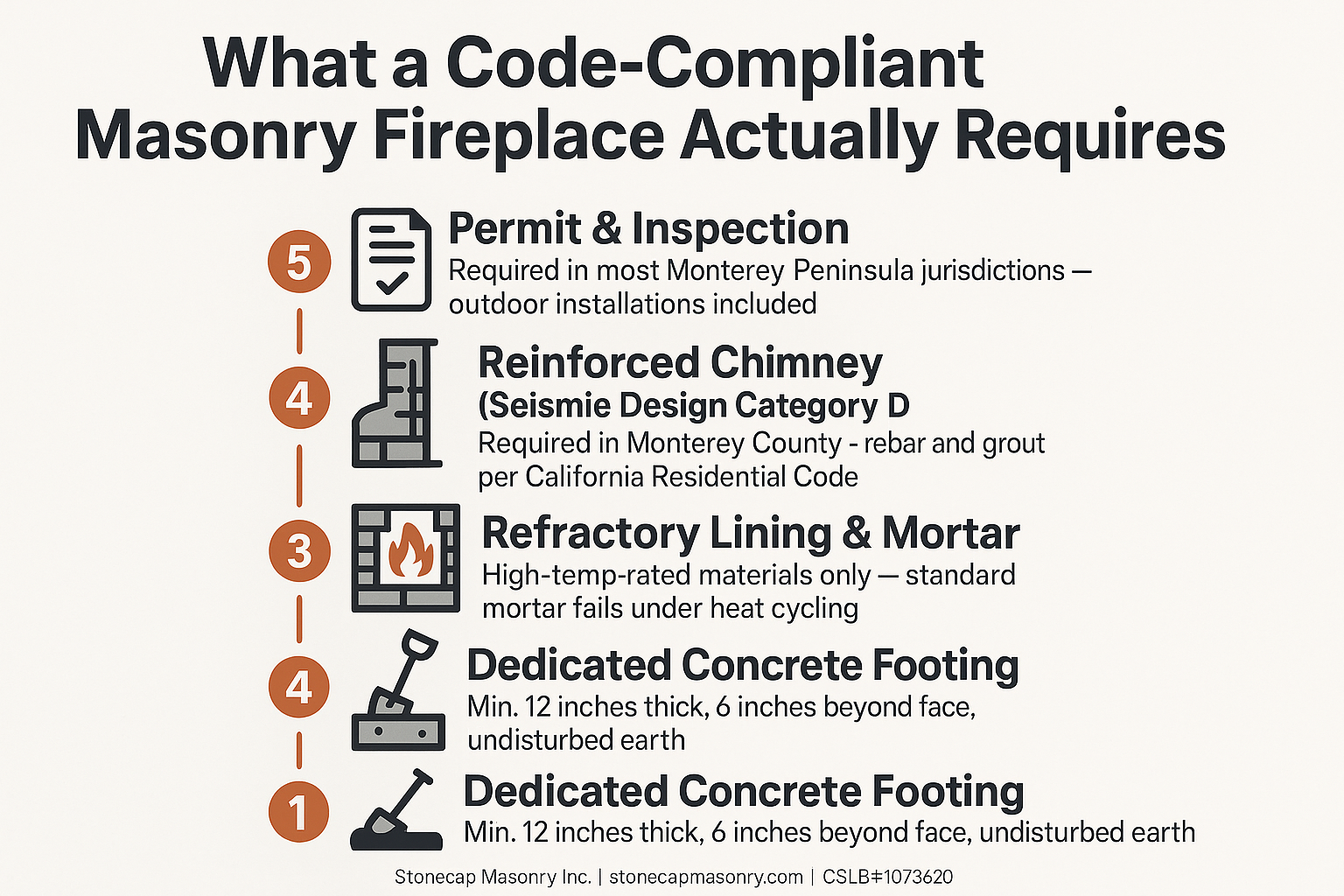
A proper masonry fireplace requires a dedicated concrete footing that is at least 12 inches thick and extends at least 6 inches beyond the face of the fireplace on all sides. That footing must be founded on undisturbed earth, not on fill or compacted base material. In Salinas and parts of the Monterey Peninsula where expansive clay soils are common, the depth of that footing matters even more — soil that shrinks and swells seasonally will transmit movement directly into any structure resting on it.
Skipping or undersizing the footing is one of the most consistent reasons masonry fireplaces crack or settle within a few years of construction. It’s also one of the most reliable ways to spot a low-ball bid — a contractor who hasn’t priced proper footing excavation and concrete is working from a different spec than one who has.
The footing isn’t a detail that shows up in a finished photo. But it’s the detail that determines whether everything above it stays where it’s supposed to. If you’re comparing bids and one is noticeably lower, asking specifically what footing spec each one includes is a reasonable place to start. A knowledgeable contractor will have a clear answer.
Firebox Construction: Where Aesthetics and Code Requirements Meet
Once the footing is set, the firebox itself has to meet specific minimum standards under California’s residential building code — and those standards exist for safety reasons, not aesthetic ones.
The firebox lining rules are precise:
- Firebrick joints cannot exceed one-quarter inch in thickness
- Where no lining is used, the back and side walls of the firebox must be at least 10 inches of solid masonry
- Firebrick itself must be laid with refractory mortar rated for high-temperature exposure — standard mortar will fail under repeated heating and cooling cycles
A fireplace can look flawless on the surface and still be a code violation underneath. The facing stone, the hearth, and the mantel are what a homeowner sees when the work is done. But an inspector — or a future insurance claim — looks at the firebox construction behind that face.
This is also where the connection between cosmetic work and structural integrity matters. If you’re ever evaluating existing masonry for signs of deeper problems, The Real Difference Between a Cosmetic Fix and a Masonry Repair covers how to tell the difference between surface wear and something that needs real attention.
For most Monterey County homeowners, the practical implication is this: a correctly built firebox takes more time and material than a shortcut version. If a bid doesn’t account for that time and material, something in the spec has been reduced.
The Layers of a Code-Compliant Masonry Fireplace
A masonry fireplace has several distinct structural layers — each with its own code requirements. Here’s how they stack up from the ground to the chimney top.
Seismic Requirements in Monterey County: The Layer Most Homeowners Don’t Expect
California is seismically active, but not every part of the state carries the same design requirements. Most of Monterey County falls within Seismic Design Category D — a classification that triggers specific reinforcement requirements for masonry chimneys under the California Residential Code.
For homeowners, that means a masonry chimney isn’t just a stack of mortared block. In SDC D, chimneys must be reinforced with steel and filled with grout to resist lateral movement during a seismic event. This requirement affects the structural design of the chimney, the size of the permit drawings needed before construction begins, and the amount of material and labor involved.
A chimney that looks identical on the outside may or may not meet this requirement depending on what’s inside it. That distinction matters — both for the safety of the structure and for what happens during a building inspection.
For a deeper look at how seismic classification shapes masonry construction decisions across different project types, How Seismic Risk Changes the Way Commercial Masonry Should Be Built covers that territory in detail. The principles that apply to commercial structures are relevant to residential chimneys as well.
Fuel Type, Venting, and the Decisions That Have to Happen Before Any Stone Is Set
One of the most consistent points of confusion homeowners bring to a fireplace project is thinking the fuel decision can wait. It can’t.
Under California’s Title 24 energy code — the 2025 edition, which became mandatory on January 1, 2026 — any gas fireplace installed as part of new construction, an addition, or a remodel must meet energy efficiency requirements. Specifically:
- Standing pilot lights are prohibited in new gas fireplace installations
- An outside combustion air intake is required
- Ventless gas fireplaces are restricted or outright banned in many California jurisdictions
These aren’t hypothetical concerns — they directly affect the venting configuration, the chase dimensions, the gas line routing, and what a building inspector will look for during final review. If a homeowner decides mid-project to switch from wood-burning to gas, significant work may need to be redone.
The outdoor fireplace question comes up regularly as well. Several homeowners in Monterey County have assumed that because a fireplace is outside, it operates under different rules. In most jurisdictions on the Monterey Peninsula, outdoor fireplaces still require a building permit, proper clearance compliance, and — for gas installations — verified gas line integrity. Starting work without a permit in California can result in a mandatory work stoppage, a retroactive permit application, and double the standard permit fees. That’s a real cost that a knowledgeable contractor will walk through before any work begins.
For anyone sorting through the wood-versus-gas decision specifically, Gas vs. Wood: What That Choice Really Means for a Masonry Fireplace Build covers the practical trade-offs in detail. And if the project includes an outdoor fireplace, What to Know Before Building an Outdoor Fireplace on the Monterey Peninsula is worth reading before calling anyone for a quote.
Key Build Requirements at a Glance: Masonry Fireplace Construction in Monterey County
These are the major code and construction requirements that apply to masonry fireplace projects in most Monterey County jurisdictions. Requirements may vary — always confirm with your local planning or building department.
| Component | Minimum Requirement | Why It Matters |
|---|---|---|
| Concrete Footing | 12″ thick, extends 6″ beyond face, undisturbed earth | Prevents settling and cracking over time |
| Firebox Lining | Firebrick with max 1/4″ joints, or 10″ solid masonry walls | California Residential Code safety minimum |
| Mortar Type | Refractory (high-temp rated) inside firebox | Standard mortar fails under heat cycling |
| Chimney Reinforcement | Steel rebar + grout required (Seismic Design Category D) | Monterey County seismic zone requirement |
| Gas Fireplace (Title 24, 2025) | No standing pilot; outside combustion air intake required | Mandatory for new installs as of Jan 1, 2026 |
| Permit | Required in most Monterey Peninsula jurisdictions | Includes outdoor fireplaces and gas installations |
What a Detailed Bid Should Actually Include
Understanding what goes into a masonry fireplace build makes it easier to evaluate what a bid does — and doesn’t — cover. When reviewing proposals, homeowners should be able to find clear answers to these questions:
- Is footing excavation and concrete spec included, and what are the dimensions?
- What firebox lining system is being used, and what mortar is specified?
- Does the chimney design account for Seismic Design Category D reinforcement?
- Has the fuel type and venting approach been determined, and does the proposal reflect the current Title 24 requirements?
- Who pulls the permit, and is that cost included?
A bid that skips these items isn’t necessarily dishonest — but it may be pricing a different scope of work. The gap between a detailed bid and a low one often lives in these specifics.
For homeowners who’ve had a poor experience with a previous contractor, that experience often traces back to a scope that looked similar on paper but had different assumptions underneath. Asking directly about each of these items before signing anything is the most reliable way to compare proposals on equal footing.
Frequently Asked Questions About Masonry Fireplace Construction
Do I need a permit to build an outdoor fireplace in Salinas or on the Monterey Peninsula?
In most jurisdictions on the Monterey Peninsula, yes — outdoor fireplaces require a building permit, especially if gas is involved. Permit requirements vary by city and by project scope, so the right answer depends on your specific location and installation type. What’s consistent is that starting without a permit in California can mean a forced work stoppage and double permit fees when you apply retroactively. A licensed contractor will confirm the requirements for your jurisdiction before work begins.
What’s the difference between a firebox lining and just using thicker masonry walls?
California’s residential building code allows either approach, but each has specific minimums. With a firebrick lining, mortar joints cannot exceed one-quarter inch and the lining must use refractory mortar. Without a lining, the back and side walls of the firebox must be at least 10 inches of solid masonry. Neither approach is automatically better — but both must meet those minimums to pass inspection.
Why does a masonry fireplace need a separate concrete footing? Can’t it just sit on the slab?
A masonry fireplace is extremely heavy — the combined weight of the firebox, chimney, and stone facing puts significant load on whatever it rests on. A residential concrete slab is typically not designed for that concentrated load, and it won’t extend deep enough to stay stable through soil movement. The dedicated footing — at least 12 inches thick, on undisturbed earth — is what keeps the structure from settling and cracking over time. Skipping it is one of the most common reasons fireplaces fail within the first few years.
Can I install a ventless gas fireplace in California?
Ventless gas fireplaces are restricted or banned in many California jurisdictions. The state’s energy and building codes have tightened significantly, and as of January 1, 2026, Title 24 requirements for new gas fireplace installations include a prohibition on standing pilot lights and a requirement for outside combustion air intake. Whether a ventless unit is allowed in your specific city or county is something to confirm with your local building department — and it needs to be resolved before any construction begins.
Does seismic reinforcement really apply to a residential fireplace chimney?
Yes. Most of Monterey County falls within Seismic Design Category D, which triggers reinforcement requirements for masonry chimneys under the California Residential Code. That means the chimney must be built with steel rebar and grout, and the structural design needs to be reflected in permit drawings before construction starts. A chimney that looks fine from the outside may not meet this requirement if it wasn’t built to spec internally.
How much does masonry fireplace construction typically cost in Monterey County?
Costs vary considerably depending on the size of the fireplace, the stone or material selected, whether it’s indoor or outdoor, fuel type, venting requirements, and site conditions like soil depth and access. Many Monterey County homeowners see project totals ranging broadly based on those variables — a modest outdoor fireplace built to code will cost meaningfully less than a large indoor stone fireplace with a reinforced chimney and custom facing. Getting an itemized quote that breaks out footing, firebox, chimney, and facing separately is the best way to understand what’s driving the number.
Planning a Masonry Fireplace on the Monterey Peninsula?
Stonecap Masonry Inc. is a licensed C-29 masonry contractor (CSLB #1073620) based in Salinas, serving homeowners across Monterey County, Carmel Valley, Pebble Beach, and Pacific Grove. Owner Candelario Pedraza Perez and his team work through the permit, footing, and code questions with clients before construction begins — not after. To talk through a project or request a site visit, call 831-262-0442 or visit stonecapmasonry.com.