
Direct Answer: In California, the gas vs. wood choice isn’t just personal preference — it determines which permits apply, which air quality rules govern the project, and how the masonry structure itself gets designed from the ground up.
Most homeowners planning a fireplace project on the Monterey Peninsula spend weeks choosing stone and maybe an afternoon thinking about gas versus wood. That order should probably be reversed. The fuel type isn’t a finishing detail — it’s one of the first decisions that shapes the entire build.
Choosing the wrong path late in the planning process can mean redesigning the firebox, pulling a different permit, bringing in additional licensed trades, or discovering that your preferred option isn’t actually available in your jurisdiction. In Monterey County, CA, those aren’t hypothetical problems. Local air quality rules, California’s building code, and the coastal environment all weigh in before a single stone gets set.
This article explains what that choice actually involves at the construction level — not the aesthetic level. If you’re planning outdoor fireplace construction on the Monterey Peninsula, start here.
Why Wood-Burning Is a Restricted Option in Most of California
Wood-burning open-hearth masonry fireplaces have been largely restricted in new construction across California for years. The reason comes down to particulate matter — specifically PM2.5, the fine particles that wood smoke puts into the air and that regional Air Quality Management Districts are required to regulate.
On the Monterey Peninsula, the relevant agency is the Monterey Bay Air Resources Board (MBARD). Before assuming a wood-burning fireplace is on the table, homeowners should contact MBARD directly or have their contractor confirm what’s currently permitted for new installations in their specific jurisdiction. Rules can vary by city, and what’s allowed in unincorporated Monterey County may differ from what’s permitted in Carmel, Pacific Grove, or Salinas.
In practice, most homeowners pursuing new fireplace construction on the Peninsula today are looking at gas. That’s not just a regulatory default — gas fire features also tend to perform better in the coastal environment, where moisture cycling and salt air make maintaining and lighting a traditional wood fire more difficult year-round. If you’re curious how the wood-burning rules apply specifically to outdoor settings, this article on whether you’re allowed to burn wood in an outdoor fireplace in Salinas covers that angle in more detail.
What California’s Title 24 Requires for Gas Fireplace Construction
If gas is the direction, the 2025 California Energy Code (Title 24) — effective January 1, 2026 — introduces specific requirements that directly affect how the masonry has to be built.
Two of the most important:
- No standing pilot lights. New gas fireplace installations must use electronic ignition. This affects how the gas system is configured and what’s accessible from the firebox.
- Outside combustion air intake is required. The structure needs a dedicated air supply pathway built into the masonry from the start — not added as an afterthought.
Vent-free gas fireplaces present a separate issue. Many California jurisdictions restrict or outright prohibit them for new installations because of indoor air quality concerns. A contractor who doesn’t flag this early can cost a homeowner real time and money if the design has to change after permitting.
The point is that the masonry structure has to be designed around these mechanical requirements, not adapted to them later. Outside air pathways, proper firebox dimensions, and chase sizing all need to account for what the gas system will require before the first course of stone goes down.
Fireplace Construction Is a Multi-Trade Project — Not Just Masonry
One thing homeowners regularly underestimate is how many licensed trades a fireplace build actually involves. A masonry contractor holds the structural scope — the firebox, the surround, the chimney or chimney chase, the hearth extension, any stone or block work. But the masonry contractor is not the only person on the job.
For a gas fireplace or gas fire pit, the gas line work must be performed by a licensed plumber or gas fitter. A C-29 masonry classification — the license held by Stonecap Masonry — covers masonry construction. It does not cover gas piping. Any contractor who tells you they’ll handle the gas line under a masonry license is operating outside their classification, which creates liability for the homeowner.
Depending on the scope, a full project might involve:
- A masonry contractor for structural work, firebox, and stone installation
- A licensed plumber for gas supply line and connection
- A building inspector for permit sign-off at framing and final stages
For interior fireplaces with gas inserts, an electrician may also be needed for ignition wiring. A well-run project has these trades sequenced in the right order — masonry rough-in, gas rough-in, inspection, then finish work. When that sequence gets scrambled, it usually means tearing into finished stone to correct something that should have been done earlier.
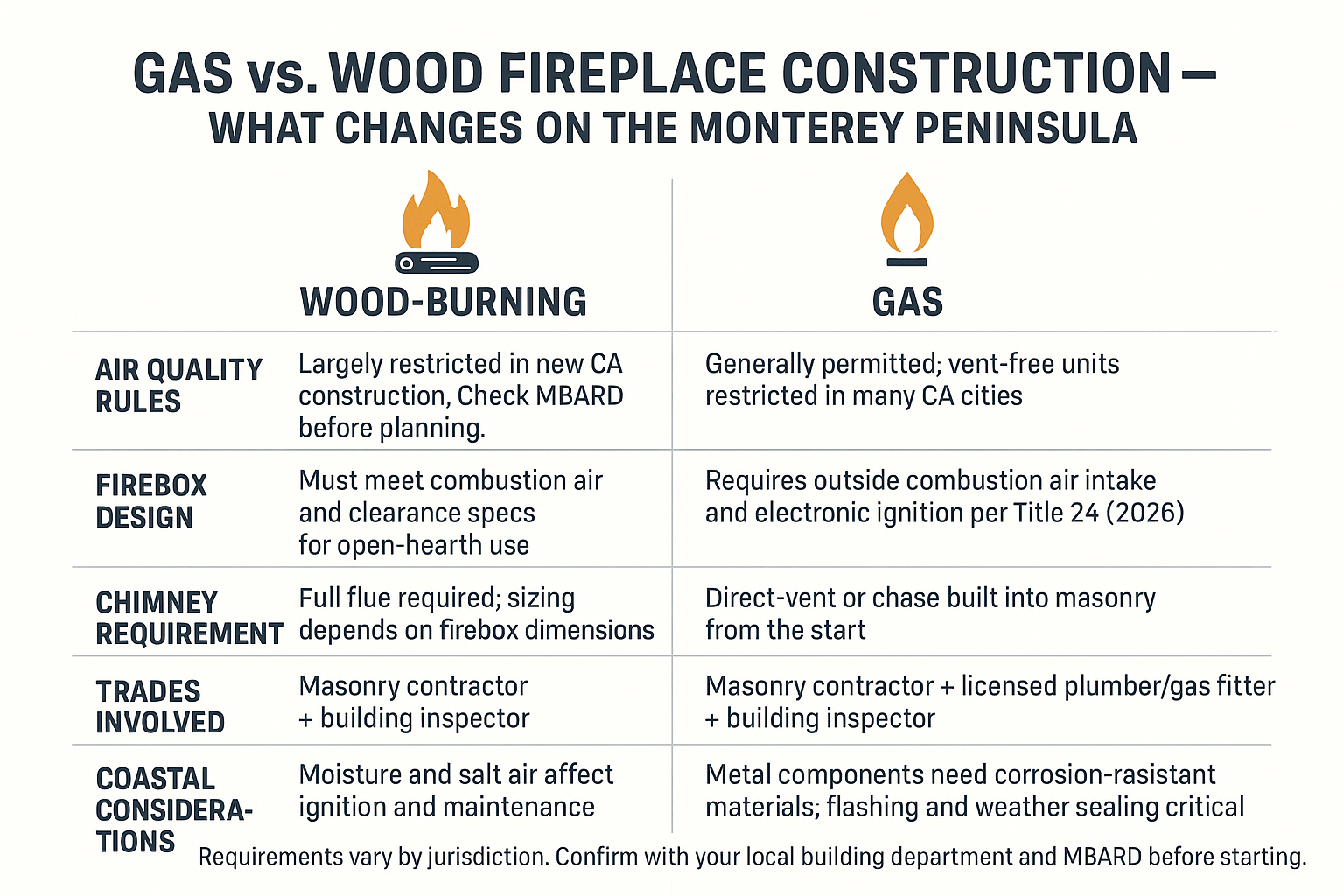
Gas vs. Wood Fireplace: What Changes at the Construction Level
This comparison shows the key differences between gas and wood fireplace construction on the Monterey Peninsula — from permitting to materials to trades involved.
How Coastal Conditions Affect Material Choices for Gas Installations
Properties in Carmel, Pebble Beach, and Pacific Grove face conditions that most fireplace guides don’t account for. The combination of salt air, coastal fog, and moisture cycling accelerates corrosion on metal components — and a gas fireplace has more metal components than a wood-burning one.
Flashing around gas line penetrations through masonry, the gas valve housing, the ignition components, and any decorative metalwork around the firebox all need to be specified with the coastal environment in mind. Stainless steel and coated fittings are common choices. Regular galvanized hardware that might last 15 years inland can show significant corrosion in five years near the Monterey Bay.
Weather sealing around any masonry penetration — whether for a gas line, a combustion air intake, or a vent — is not optional in this climate. Salt air finds any gap. If a gas line enters the masonry without proper flashing and sealant, the penetration becomes a pathway for moisture, and moisture in masonry on the Central Coast is a repair problem waiting to happen. Understanding how that moisture cycling affects masonry over time is useful context — this article on hardscape performance in Salinas soil and weather explains the environmental variables in more detail.
Outdoor Fireplace vs. Gas Fire Pit — Different Permitting Paths
Homeowners frequently assume that a fire pit and an outdoor fireplace follow the same permitting rules. They don’t — and the differences affect timeline, cost, and which trades need to be on the job.
| Feature | Outdoor Masonry Fireplace | Gas Fire Pit |
|---|---|---|
| Structure type | Firebox, chimney or chase, hearth — permanent structure | Open bowl or ring, may have gas burner — varies by design |
| Permit required? | Yes, in most Peninsula jurisdictions | Often yes if gas-connected; varies by city and size |
| Masonry scope | Full firebox construction, stone surround, chimney | Base, surround, and cap work; gas insert set by plumber |
| Gas trade required? | Yes, for gas line and connection | Yes, if gas-connected — not a masonry scope item |
| Title 24 applies? | Yes — outside air intake, no standing pilot | Applies to gas systems; confirm with local building dept. |
| Inspection stages | Typically framing/rough-in and final | Final inspection common; may vary by jurisdiction |
What This Means for Project Planning and Timeline
One of the more common frustrations homeowners describe when calling about fireplace projects is discovering mid-project that the timeline is longer than they expected. A lot of that comes from not accounting for the permitting sequence and trade coordination upfront.
A straightforward gas outdoor fireplace on a Pebble Beach property, for example, might involve:
- An initial site assessment and design conversation
- Permit application submittal — processing times at Monterey County or city planning departments can run several weeks to a couple of months depending on current workload
- Masonry rough-in, followed by the plumber running the gas line
- Rough-in inspection before any finish stone work covers the infrastructure
- Final inspection after completion
Homeowners who start the permitting process early — ideally before final material selection — tend to have much smoother projects. Those who assume permits are a quick formality often find themselves waiting on an inspector while a partially finished fireplace sits in their backyard.
For context on what the full scope of an outdoor fireplace build typically involves from the masonry side, Stonecap Masonry’s service page covers the range of work that falls under that project type. And if you’re planning a more comprehensive outdoor living space alongside the fireplace, outdoor patio kitchen ideas for Monterey homes is worth a look for understanding how the components typically fit together.
Frequently Asked Questions About Fireplace Construction in Monterey County
Can I build a wood-burning fireplace on my property in Carmel or Pacific Grove?
Possibly, but it’s not automatic. Wood-burning open-hearth fireplaces are restricted in new California construction under air quality rules enforced by the Monterey Bay Air Resources Board (MBARD). The specific rules depend on your city, project type, and whether this is new construction or a renovation. Contact MBARD directly, or ask your masonry contractor to confirm before you plan around it.
Does a gas fire pit need a permit in Monterey County?
In most Peninsula jurisdictions, yes — if the fire pit is gas-connected, a permit and inspection are typically required. The exact requirements vary by city and project scope. A licensed masonry contractor should be confirming permit requirements with the local building department before the project starts, not after.
Can a masonry contractor run the gas line for my fireplace?
No. Gas line work must be performed by a licensed plumber or gas fitter. A C-29 masonry contractor covers structural masonry — not gas piping. A well-organized fireplace project will coordinate both trades in sequence, with the masonry rough-in happening before the gas line is run and inspected.
What does Title 24 actually require for a new gas fireplace?
Under the 2025 California Energy Code (Title 24), effective January 1, 2026, new gas fireplaces must use electronic ignition — no standing pilot lights. They also require a dedicated outside combustion air intake built into the masonry structure. Vent-free gas fireplaces are restricted or prohibited in many California cities. These requirements need to be built into the design from the start.
How much does a masonry fireplace typically cost on the Monterey Peninsula?
Costs vary significantly based on scope, materials, site conditions, and whether you’re building indoors or outdoors. A custom outdoor masonry fireplace on the Monterey Peninsula can vary quite a bit — many Monterey County homeowners see project totals somewhere in the range of $15,000 to $40,000 or more depending on complexity, stone selection, and the number of trades involved. That’s a wide range because it’s a genuinely wide range in practice. Contact Stonecap Masonry directly for a project-specific quote.
How do I verify that a masonry contractor is licensed in California?
Use the CSLB’s free license check tool at cslb.ca.gov. Search by license number or business name. A legitimate C-29 masonry contractor will have an active license, bonding, and insurance you can verify before signing anything. Stonecap Masonry holds CSLB License #1073620.
Planning a Fireplace Project on the Monterey Peninsula?
Stonecap Masonry Inc. works with homeowners across Monterey County — from Salinas and Carmel Valley to Pebble Beach and Pacific Grove — on custom fireplace and fire feature builds that are designed around local code requirements from day one. If you’re early in the planning process and want to talk through what’s involved before committing to a design direction, reach out at 831-262-0442 or visit stonecapmasonry.com to request a quote.
