Direct Answer: Building an outdoor fireplace on the Monterey Peninsula requires a permit, coastal-grade materials, and a solid base — the salt air, clay soil, and seismic exposure here make each of those non-optional.
An outdoor fireplace sounds straightforward until a contractor pulls up, looks at your yard, and starts asking questions you weren’t expecting — about soil, setbacks, gas lines, and smoke ordinances. On the Monterey Peninsula, those questions have specific answers that affect your cost, your timeline, and whether the structure lasts 30 years or starts cracking in five.
This isn’t a mild climate. Salt air off the Monterey Bay, clay-heavy soils in Salinas and Carmel Valley, and Monterey County’s seismic exposure put masonry under real stress. A fireplace built without accounting for those conditions will show it — in spalled stone, failing mortar joints, or a firebox that shifts at the base.
What follows covers the three things that matter most before you break ground: the permit reality in Monterey County, what the coastal environment actually does to your material choices, and what proper base construction looks like for this specific region. Skip any one of them and the project gets more expensive to fix than it was to build.
The Permit Reality for Outdoor Fireplaces in Monterey County
Most homeowners assume a backyard fireplace is too small to need a permit. That assumption costs them later. In California, an outdoor fireplace with a firebox — wood-burning or gas — is considered a permanent structure. It requires a building permit in virtually every jurisdiction on the Monterey Peninsula, including the City of Monterey, Carmel-by-the-Sea, Pacific Grove, and unincorporated Monterey County.
The permit triggers a few things worth knowing:
- Setback requirements vary by parcel and zone. In many residential zones, a fireplace must sit at least 10 feet from property lines and structures — but that can change depending on your specific lot. Always verify with your local planning department before finalizing placement.
- Wood-burning fireplaces face additional restrictions. The Monterey Bay Air Resources District regulates air quality across the region, and wood-burning appliances require approval. Some areas allow them with a certified firebox insert; others restrict open-hearth wood burning entirely on spare-the-air days.
- Gas fireplaces require a gas line run from your home’s service, which means a licensed plumber pulls a separate permit for that portion of the work — the masonry contractor does not handle gas.
- California’s Title 24 building standards, updated for 2026, apply to any permitted masonry structure. A licensed C-29 contractor will know how those standards affect firebox construction, hearth dimensions, and clearance to combustibles.
The permit and materials process for fire features follows a similar framework for fire pits — the rules for a full outdoor fireplace are typically more involved, not less. Pull the permit. The alternative is a stop-work order, a required demolition, or a disclosure problem when you sell.
Why Coastal Conditions Change Your Material Choices
Salt air is abrasive in ways that don’t show up immediately. Within two to five years, masonry built with the wrong mortar mix or porous stone can start showing efflorescence, spalling, or joint erosion — especially within a mile or two of the Monterey Bay. In Pebble Beach and Pacific Grove, that exposure is constant. Even inland areas like Carmel Valley see moisture cycling that’s harder on masonry than most of California’s inland regions.
The material decisions that matter most for a coastal outdoor fireplace:
- Stone selection: Dense, low-absorption stones — granite, quartzite, and certain basalts — hold up significantly better than softer sedimentary options like sandstone or some limestones. Porosity determines how much moisture a stone absorbs and releases through temperature cycles.
- Mortar type: Type S mortar is the standard for outdoor masonry in California, but a mason working near the coast may choose a higher-strength mix or add a polymer modifier for better resistance to moisture intrusion. The mix matters as much as the stone.
- Firebox materials: The interior of a wood-burning firebox must use refractory brick and refractory mortar — standard brick and mortar will not survive the thermal cycling. This is non-negotiable from both a safety and longevity standpoint.
- Capstones and hearth surfaces: These take direct weather exposure on the top face. Natural stone caps should be sloped slightly to shed water rather than let it pond and penetrate the joint below.
The relationship between material selection and long-term durability is something worth reading before you finalize stone choices with any contractor. What looks great in a showroom may not behave well in a Carmel fogbelt backyard.
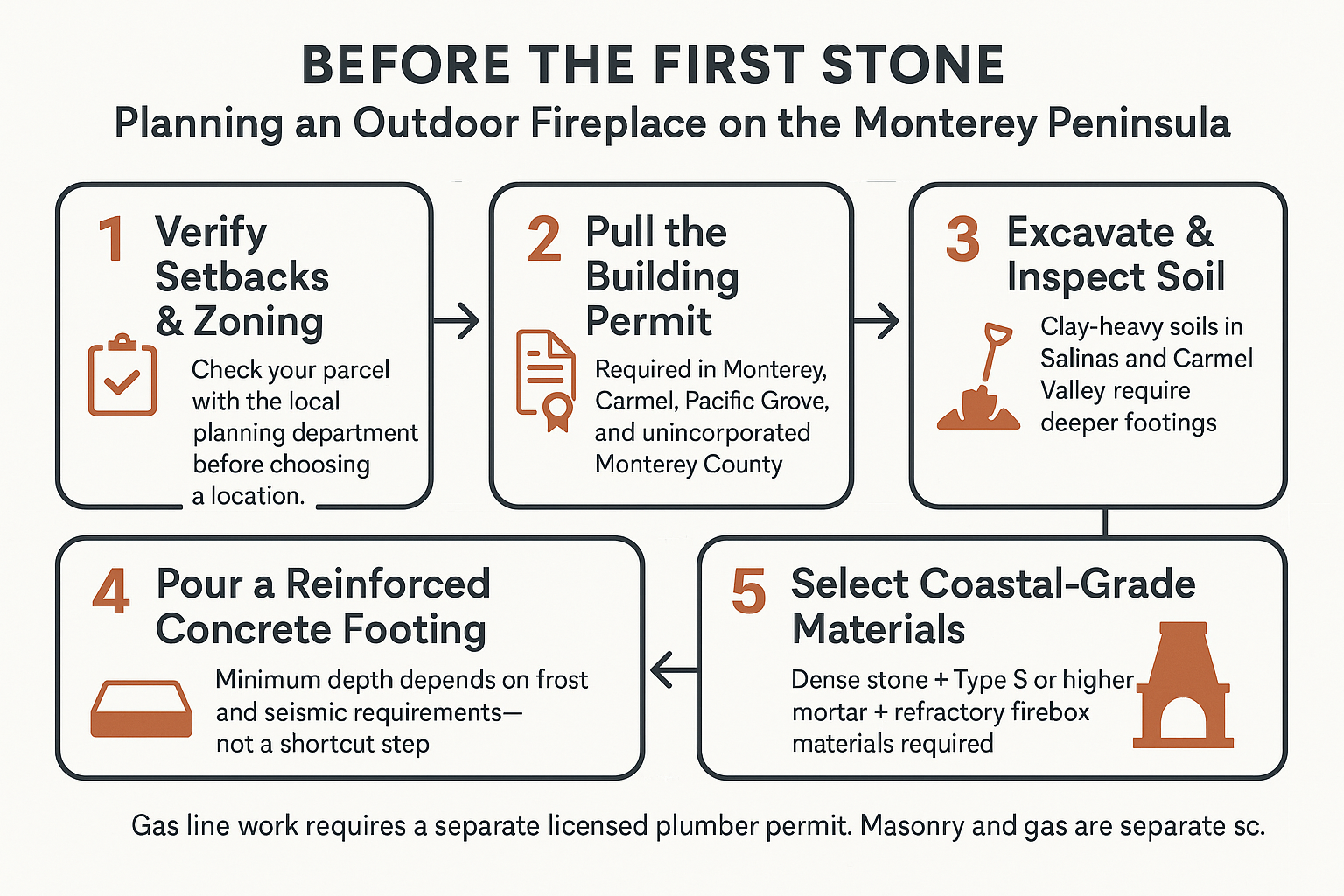
Outdoor Fireplace Planning: What Has to Happen Before the First Stone Goes Down
This overview shows the sequence of decisions and site work that come before any masonry construction begins on an outdoor fireplace.
The Foundation Work That Most Homeowners Never See
An outdoor fireplace is heavy — a mid-size natural stone structure can weigh 8,000 to 15,000 pounds by the time it’s complete. That load has to go somewhere, and on the Monterey Peninsula, where soils range from expansive clay in Salinas to sandy loam near the coast, it has to go onto a properly engineered concrete footing.
A footing for an outdoor fireplace is not a simple concrete pad. It needs to be:
- Excavated below any organic or fill soil — typically 18 to 24 inches deep in most Monterey County residential sites, sometimes deeper depending on soil conditions
- Reinforced with rebar in a grid pattern appropriate for seismic zone loads — Monterey County sits in a high seismic hazard area
- Sized to distribute load across enough surface area that settlement is minimized, even through seasonal moisture changes
Skimping on the footing is the most common reason outdoor fireplaces develop structural cracks within a few years. The fireplace looks fine at completion, then after one or two rainy seasons the base shifts and a crack appears in the firebox or chimney. That’s a structural failure, not cosmetic damage — and it costs far more to repair than it would have to build the footing correctly the first time.
For Salinas homeowners especially, the site preparation considerations that apply to hardscape apply equally to fireplace foundations. Clay soil swells when wet and shrinks when dry. A footing that doesn’t account for that movement won’t hold a static structure, let alone one exposed to thermal expansion from repeated fire cycles.
Budget-wise, expect the footing and base work alone to represent 20 to 30% of the total project cost on a well-built outdoor fireplace. That’s not a place where competitive bids that come in significantly lower are saving you money — they’re skipping steps.
Outdoor Fireplace Cost Ranges on the Monterey Peninsula
These are general ranges based on typical project scopes in Monterey County. Actual costs vary based on site conditions, material selection, gas versus wood-burning, and permit fees specific to your jurisdiction.
| Project Scope | Estimated Cost Range | Key Variables |
|---|---|---|
| Prefab insert with stone veneer surround | $8,000 – $14,000 | Veneer stone type, hearth material, chimney height |
| Custom masonry wood-burning fireplace | $18,000 – $35,000 | Footings, refractory firebox, natural stone, chimney cap |
| Custom gas fireplace with outdoor kitchen integration | $30,000 – $60,000+ | Gas line, custom stonework, countertop, permit complexity |
| Permit fees (Monterey County / City) | $500 – $1,500+ | Jurisdiction, project valuation, plan check scope |
| Footing and base preparation (standalone) | $2,500 – $6,000 | Soil conditions, depth required, rebar specification |
How to Evaluate a Masonry Contractor Before You Hire One
Outdoor fireplaces attract a wide range of contractors — some are licensed C-29 masons, others are general handymen or landscapers who do masonry work on the side. On a structure that involves combustion, structural load, and a building permit, the distinction matters.
In California, you can verify any contractor’s license in about 60 seconds through the CSLB’s check-a-license tool at cslb.ca.gov. Look for:
- An active license status — not expired or suspended
- The correct classification — a C-29 covers full masonry scope; other classifications may not
- Bonding and insurance on file — if a worker is injured on your property and the contractor isn’t insured, you may be exposed to liability
Beyond licensing, ask any prospective contractor how they handle the footing design, what mortar mix they use for coastal applications, and whether they’ve pulled permits for outdoor fireplace projects in your specific city or county before. A contractor who’s done this work locally will have direct answers. One who hasn’t will give you vague ones.
The full breakdown of what hiring a licensed masonry contractor actually means in California is worth reading before you take any bids. And if you want to understand why two quotes for the same fireplace can differ by $10,000 or more, the reasons two stonework quotes can be wildly different covers that clearly.
Frequently Asked Questions About Building an Outdoor Fireplace on the Monterey Peninsula
Do I always need a permit for an outdoor fireplace in Monterey County?
In nearly every case, yes. A fireplace with a firebox is a permanent structure under California building code, and it requires a permit whether it’s wood-burning or gas. Requirements vary slightly between jurisdictions — the City of Monterey, Carmel-by-the-Sea, Pacific Grove, and unincorporated Monterey County each have their own planning departments. Always confirm with your local office before construction starts.
Can I burn wood in an outdoor fireplace near the Monterey Bay?
It depends on your location, your firebox type, and the air quality forecast. The Monterey Bay Air Resources District restricts wood burning on spare-the-air days, and some jurisdictions have additional rules for open-hearth wood fireplaces. EPA-certified firebox inserts are generally allowed where open hearths aren’t. If you want the flexibility to burn wood legally, discuss firebox options with your contractor before construction — changing it after the fact is expensive.
How long does it take to build an outdoor fireplace?
From permit application to final inspection, most outdoor fireplace projects on the Monterey Peninsula take 8 to 16 weeks total. Permit processing alone can run 3 to 6 weeks depending on the jurisdiction and project complexity. The physical construction of a custom masonry fireplace typically takes 1 to 3 weeks of active site work, depending on scope and weather.
What’s the difference between a prefab fireplace and a full masonry build?
A prefab fireplace uses a manufactured metal firebox set into a masonry surround — it’s faster to build and less expensive, typically $8,000 to $14,000 finished. A full masonry fireplace is built entirely from brick, block, and refractory materials, with no metal insert. Full masonry builds take longer, cost more, and require a more experienced contractor — but they’re more durable long-term and look distinctly different. Which is right depends on your budget, timeline, and how the fireplace fits into the rest of your outdoor space.
Does a gas outdoor fireplace require a separate contractor?
Yes. The gas line connection must be installed by a licensed plumber or gas contractor under a separate permit. Your masonry contractor builds the structure; the plumber runs the supply line and connects the burner. Both scopes need to be coordinated so the gas stub-out is placed correctly before the masonry is closed up. A contractor who says they handle the gas work themselves — without a plumbing license — is a red flag.
How do I know if a crack in my outdoor fireplace is serious?
Hairline cracks in mortar joints after the first season are common and often cosmetic — the structure is settling and going through its first thermal cycles. Cracks that run through the stone or brick itself, cracks that are wider than 1/4 inch, or any cracking at the base of the structure are worth having a licensed mason evaluate. The difference between cosmetic damage and structural failure is something a qualified contractor can assess quickly and explain clearly.
Ready to Plan Your Outdoor Fireplace the Right Way?
Stonecap Masonry Inc. has worked on outdoor fireplace projects across the Monterey Peninsula — from Salinas residential backyards to Carmel properties where coastal exposure and high-end stone selection both require careful attention. If you’re in the early stages of planning and want a straight conversation about what your site, budget, and jurisdiction actually require, you can reach the Stonecap team at 831-262-0442 or through stonecapmasonry.com.
