Here’s a truth learned over decades in this business: what lies beneath your hardscape matters far more than what you see. A stunning patio can hide a disaster-in-the-making, with a weak foundation that guarantees cracks and sinking in just a few years. Lasting quality comes from treating hardscaping as serious construction—not a cosmetic touch-up.
Understanding the truth about hardscape contractors and long-term durability is the first step. It protects your investment and ensures you get a beautiful, safe outdoor space that lasts for decades, not just a season.
Why Most Hardscapes Fail While Others Last Decades
We’ve all seen the beautiful portfolio photos—gleaming new patios and elegant stone walls. But the real test isn't how it looks on day one; it's what you see ten years down the road. Is that patio still level, or has it become a lumpy, hazardous mess?
The difference between a hardscape that stands the test of time and one that quickly falls apart almost always boils down to the contractor’s core philosophy. It's about engineering versus aesthetics.
The Construction Mindset vs. The Landscaping Mindset
Many contractors approach hardscaping as just another part of landscaping. They focus on the visuals—the color of the pavers, the pattern of the stones—while treating the structural work as an afterthought.
A true mason or hardscape expert thinks differently. We see a patio, walkway, or retaining wall as a permanent structure that must battle the elements every day. That requires a construction mindset grounded in solid engineering principles.
The fate of your hardscape is sealed long before the first paver is ever laid. It all comes down to the foundation—the quality of the excavation, the precision of the compaction, and the engineering of the drainage. A purely cosmetic approach skips right over this.
Where Most Failed Projects Go Wrong
When a contractor prioritizes looks over structural integrity, they set you up for failure, especially in the unique conditions around Monterey Bay. You can see more on this in our advanced guide to hardscaping that most homeowners never get. When essential steps are skipped, you get predictable problems.
- Sinking and Heaving: This happens when the base is too shallow or poorly compacted, leaving it unable to support the weight above.
- Cracking and Shifting: You'll see this when the soil wasn't properly prepared and there's no plan to get water away from the structure.
- Wall Failure: When a contractor fails to install proper drainage, hydrostatic pressure builds up behind the wall until it literally pushes it over.
Hiring someone who understands the local soils and climate of Carmel, Salinas, or Pebble Beach is the single most important decision you'll make. Their expertise is what will protect your investment for decades.
The Unseen Foundation: The Secret to Long-Term Durability
Every beautiful hardscape project has a secret hero you'll never see: its base. A patio or walkway is only as good as the foundation supporting it, and cutting corners here is a guaranteed recipe for failure.
Think of it like building a house. You wouldn't put up walls without a solid, professionally engineered foundation. The same principle applies here, involving careful excavation and building back up with layers of mechanically compacted aggregate.
This chart breaks down how a hardscape's initial look, its underlying structure, and its ability to last for years are all interconnected.
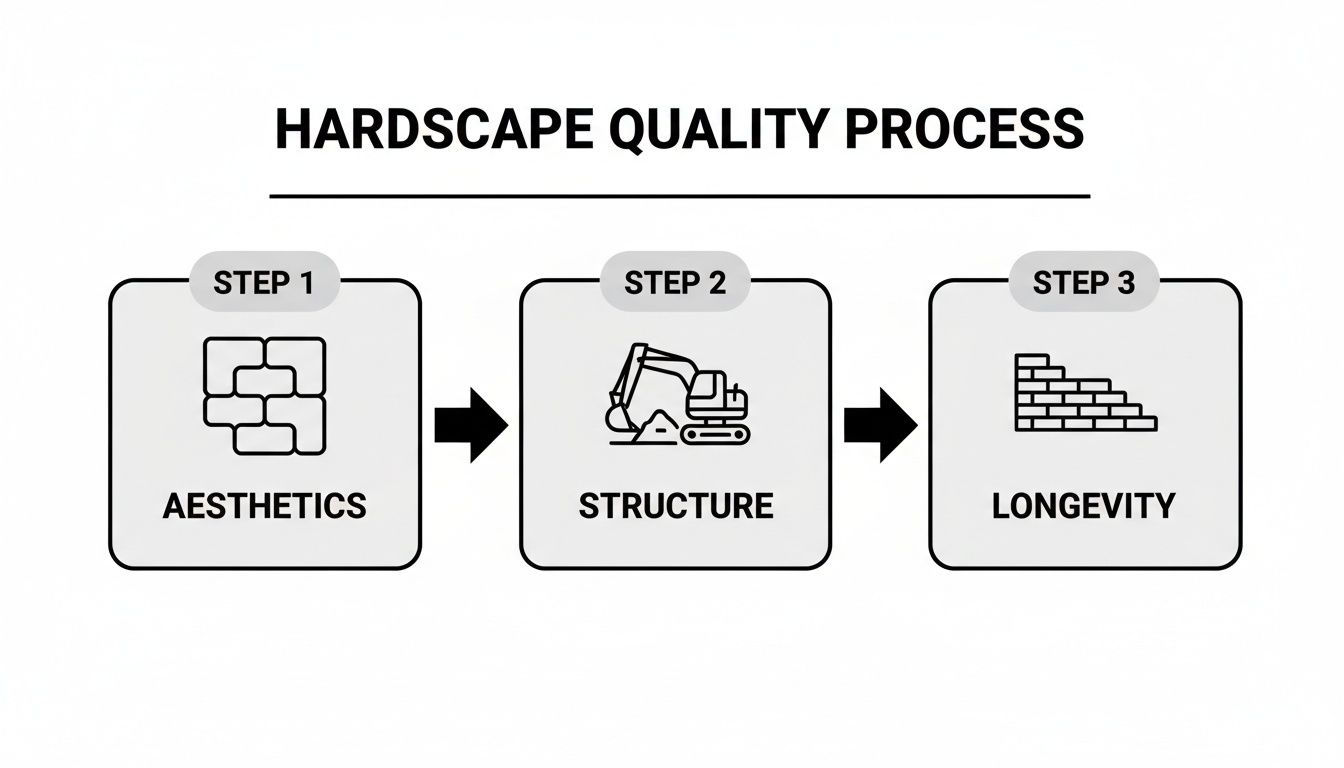
As you can see, the pretty surface is just the beginning. The structural work happening below ensures your investment stands the test of time.
Why Monterey Bay Soils Change Everything
A cookie-cutter approach to base preparation is a massive red flag in Monterey County. Our local soils are anything but uniform, ranging from sandy loam in Pebble Beach to heavy, expansive clay further inland around Salinas.
- Sandy Loam: This soil drains nicely but can be unstable if not properly contained. A professional knows how to lock the base in to prevent erosion and shifting.
- Expansive Clay: This soil swells when wet and shrinks when dry, causing the ground to heave. This requires a much deeper and more robust base to create a stable platform.
A contractor's deep understanding of these local conditions isn't just a "nice-to-have"—it's essential for a project that lasts. They must adjust the depth, materials, and compaction techniques based on your specific property.
However, even the best plan falls apart without a skilled team. According to a recent industry report, sustained demand and labor shortages are increasing the cost of rework when installations fail, directly impacting homeowners. (Stonecap Masonry Strategic Report, 2024).
When a company can't keep an experienced team together, it’s the client who pays the price down the road with failing expertly constructed retaining walls and patios.
How Water Management Protects Your Hardscape Investment
Water is the silent enemy of hardscaping. It might not seem like a threat, but it's the single biggest reason beautiful patios and walls fail prematurely. A brand-new paver patio can look perfect, but if water is moving uncontrolled beneath it, it's a ticking time bomb.
This is especially critical for retaining walls. When heavy rain soaks the soil behind a wall, it becomes incredibly heavy and exerts immense hydrostatic pressure. This is the #1 cause of bulging, cracking, and eventual collapse.
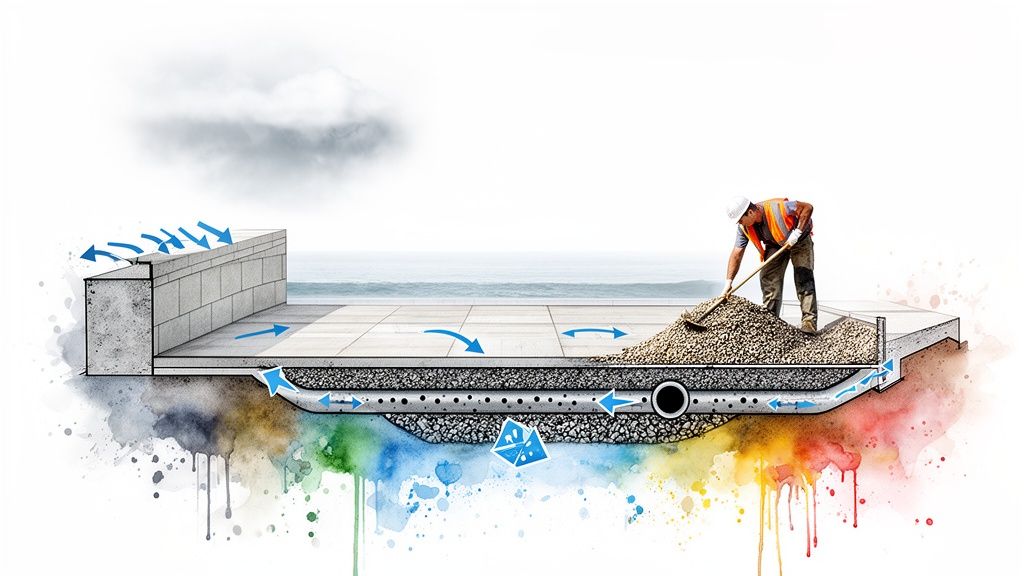
It’s the same story for patios and walkways. When water gets trapped underneath and freezes—even during our milder winters—it expands. This cycle, known as frost heave, can lift and shift entire sections of pavers, creating an uneven mess.
Engineering a Defense Against Water
A true hardscape professional engineers a complete system to control water from the start. They build in defenses that will last for decades.
A pro’s toolkit for fighting water damage always includes a few key strategies:
- Proper Grading: The surface must be sloped, even if you can't see it. A subtle 2% grade is typically enough to channel surface water away from your home.
- French Drains: Behind a retaining wall, a gravel-filled trench with a perforated pipe is essential. It intercepts groundwater before it can build up destructive pressure.
- Permeable Materials: Using permeable pavers or special base materials allows rain to drain straight into the ground. This reduces runoff and prevents pressure buildup.
Here in coastal communities like Carmel and Pacific Grove, with our seasonal rains and fog, this kind of planning isn't optional. It's essential for long-term durability.
A contractor who starts a conversation by asking about drainage and slopes is focused on building something that lasts. A contractor who only wants to talk about paver colors might be ignoring the very thing that will tear their work apart.
How a contractor handles water is one of the clearest signs of their skill. It's what separates a project that looks good for a year from an investment that adds value for a lifetime.
Why Your Contractor's Business Stability is Non-Negotiable
When you hire a contractor, you're not just buying a service; you're investing in a long-term relationship. The durability of your new patio is directly tied to the health of the contractor's business.
Think about it: that gorgeous new hardscape is only as good as the warranty backing it. If the company that built it goes out of business, that warranty is just a piece of paper.
The failure rate in the construction industry is shockingly high. According to the U.S. Bureau of Labor Statistics, of all construction businesses started in March 2011, only 35.9% were still operating by March 2022.
This turns your hiring decision into an exercise in risk management. An out-of-business contractor means any guarantee they offered vanishes, leaving you to foot the bill for repairs that should have been covered.
Choosing a Partner for the Long Haul
This is why finding a contractor with a proven history in the Monterey Bay area is so critical. A company that has served communities from Salinas to Carmel for years has demonstrated they know how to run a stable business.
A contractor with a steady stream of projects is a good sign of their stability. If you're curious about what it takes for them to stay busy, you can check out this guide: A Simple Guide to Getting More Contractor Jobs. Simply put, a busy contractor is a stable contractor.
To help you tell the good from the bad, here's a quick cheat sheet.
Contractor Red Flags vs Green Flags
| Red Flag (Warning Sign) | Green Flag (Positive Sign) |
|---|---|
| No physical address or only a P.O. Box | A local, physical office or workshop you can visit |
| Vague or missing license/insurance info | Proactively provides license and insurance certificates |
| Demands a large upfront cash deposit | Offers a clear, professional payment schedule |
| Pressure to sign a contract immediately | Encourages you to take your time and ask questions |
| No online presence or a brand new website | A long-standing website with a portfolio and reviews |
| Can't provide recent, local references | Has a long list of happy clients in your area |
Spotting these signs can save you a world of headaches. A reliable professional will proudly display their credentials and business history.
Choosing a licensed, bonded, and insured contractor isn't just about checking boxes—it’s your primary defense against financial loss and shoddy workmanship. It confirms they meet California's standards for professionalism and are accountable for their work.
A contractor's longevity speaks volumes about their quality and reliability. In fact, local requirements are becoming even more strict. You can learn more about how Central Coast licensing rules are tightening and what homeowners should look for.
Adapting Hardscapes to California's Environmental Demands
Generic hardscaping advice you find online often fails spectacularly here in California. A beautiful patio designed for a stable, dry climate will quickly fall apart when it meets the unique pressures we face along Monterey Bay.
Our region demands a specialized game plan that accounts for seismic activity, wildfire risks, and corrosive coastal air. A contractor who doesn't understand these local challenges is, frankly, building on borrowed time.
Engineering for Seismic Resilience
Living in California means living with the reality that the ground beneath our feet can, and will, move. A skilled mason knows how to engineer hardscapes to be earthquake-resistant.
This resilience comes down to specific construction techniques:
- Proper Reinforcement: For solid structures like retaining walls, steel rebar is non-negotiable. It provides the tensile strength needed to hold masonry together when the ground shakes.
- Flexible Jointing: Using polymeric sand for paver patios gives individual pavers room to move slightly. This prevents them from cracking or buckling under stress.
- Segmental Retaining Walls: These systems are engineered with a degree of flexibility built right in, allowing them to shift with ground movement without losing structural integrity.
Defending Your Home Against Wildfire
For anyone living in areas like Carmel Valley, wildfire is a constant threat. Your hardscape is a critical part of your home's defensible space.
A contractor worth their salt will guide you toward using non-combustible materials like natural stone, concrete pavers, and brick. These materials create a fire-resistant buffer zone around your home, cutting off fuel sources.
Combating Coastal Corrosion
If your home is in Pebble Beach, Monterey, or Pacific Grove, you’re fighting the relentless salty coastal air. That salt-laden moisture is incredibly corrosive.
An experienced local contractor knows this battle well. They’ll select materials proven to withstand this environment, from corrosion-resistant rebar to specific mortar formulations, ensuring long-term durability on the coast.
How to Vet a Hardscape Contractor and Ensure Project Success
Now that you know what makes a hardscape last, you're ready to vet potential contractors like a pro. The goal is to see past the glossy photos and find a true craftsman—someone who geeks out on structural integrity, not just aesthetics.
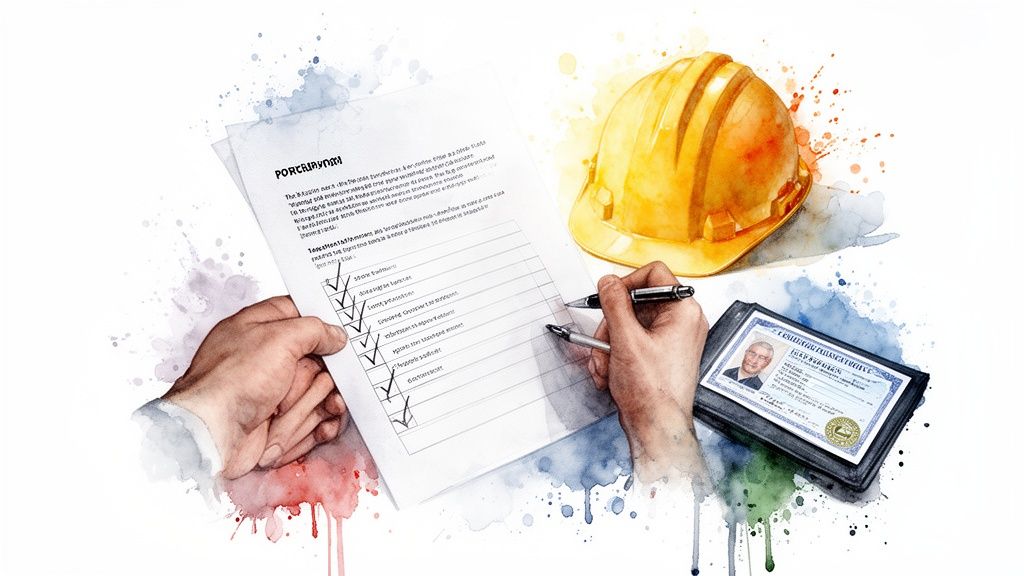
The single most revealing document you’ll get is the proposal. If a contractor hands you a vague, one-page quote that only lists materials and a final price, consider it a giant red flag. What you need is a detailed, written proposal that maps out the entire construction plan.
Your Contractor Vetting Checklist
A true professional will be happy to answer detailed questions. They'll appreciate that you've done your homework.
- Base Preparation: "Walk me through your process for excavating and compacting the base. How will you adapt that for my specific soil type here in Monterey?"
- Drainage Plan: "What's your strategy for managing water and preventing hydrostatic pressure?"
- Crew Experience: "Tell me about the team who will be here. Are they your full-time employees or subcontractors? What's their experience level?"
- Code Knowledge: "How do you ensure the project will meet all of Monterey County's building codes and permitting requirements?"
Pay attention to the little things, too. Top-tier contractors often use specialized tools like Exayard AI hardscape and planting takeoff software for dead-on accurate material estimates. This shows a commitment to precision from the start.
A detailed proposal isn't just a quote; it's a window into the contractor's mind. If they can't clearly explain the structural details on paper, there's little chance they'll execute them properly in your yard.
By zeroing in on these foundational pillars, you're not just buying a patio; you're protecting your investment. Choosing the right hardscape contractor is about finding a partner who builds durability from the ground up.
Frequently Asked Questions About Hardscape Durability
What's the biggest mistake homeowners make when hiring a hardscape contractor?
The biggest mistake is choosing a contractor based on a low bid or pretty photos alone. The real secret to a hardscape that lasts is hidden beneath the surface. Focus on their process for base preparation, soil compaction, and drainage to separate the pros from the pretenders.
How deep does the base for a paver patio in Monterey County need to be?
There's no single magic number; it depends on your specific soil and intended use. For a simple walkway on stable soil, a 4 to 6-inch compacted base is standard. However, expansive clay soil common in areas like Salinas requires a much deeper, professionally engineered base to prevent heaving.
Why is drainage behind a retaining wall so critical?
Without proper drainage, rainwater soaks the soil, creating immense hydrostatic pressure that pushes against the wall. This unseen force is the number one cause of retaining wall failure. A drainage system is the wall's essential life-support system.
Is a licensed contractor really necessary for a small patio?
Absolutely. A valid contractor's license is your proof that they meet California's strict requirements for skill, insurance, and financial responsibility. Hiring an unlicensed contractor for any job is a huge gamble, leaving you with no protection if the project fails or someone gets hurt.
How can I tell if a contractor truly understands our local soil conditions?
Ask them to explain the difference between working with sandy coastal soils versus the dense clay found inland near Salinas. A true local expert will confidently detail their specific strategies for excavation, base materials, and compaction techniques adapted to your property's unique conditions.
A hardscape that stands the test of time is never an accident. It’s the direct result of expert planning, deep local knowledge, and an unwavering commitment to structural integrity from the ground up, especially given Monterey County’s climate and soils.
When you're ready to invest in your property, trust licensed professionals who understand this region. Contact Stonecap Masonry Inc. to start a conversation about building a hardscape that will last for decades.
