
Direct Answer: A loose capstone lets rain run into the wall instead of off it. Reset it only if the wall below is sound. If the whole cap line has opened up, the wall moved first.
Most people find this the same way. You lean on the top of a garden wall or push a stone cap while pulling a weed, and it rocks. Then you stand there wondering if that is one loose stone or the first sign of something bigger.
Here is how I look at it after years of wall work around Monterey County. The cap is the roof of the wall. A bedded, continuous cap sheds rain off the face. A shifted or hollow cap funnels that same water straight down into the block cores, the backfill, and the joints below where nobody can see it.
So the real question was never whether the cap is loose. It is where the water has been going since it came loose, and whether the wall under it moved first. This article covers the top of the wall only: the cap bed and the joints between caps.
What a Capstone Actually Does on a Monterey County Wall
A cap has two jobs, and looks are the smaller one.
The first job is shedding water out past the face so rain does not sit on the top course. The second is sealing the top of the assembly, especially on CMU block walls where the cores are open vertical shafts running down toward the footing.
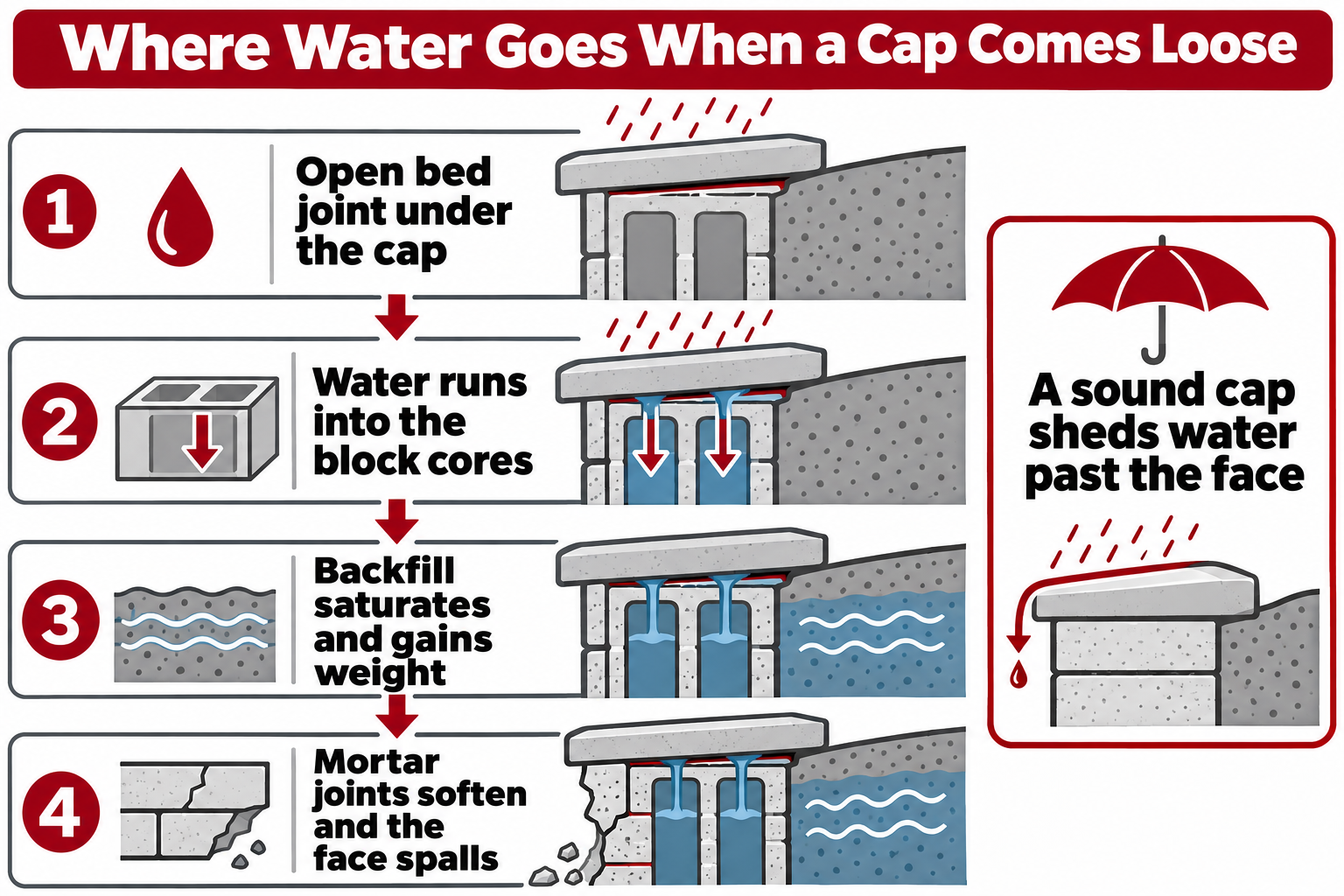
When the mortar bed under a cap breaks loose, water takes the shortest path in. That path usually ends in one of three places:
- Down the block cores, where it saturates the wall from the inside and pushes mineral salts back out through the face
- Into the backfill behind the wall, adding weight and pressure the wall was never built to hold
- Through the bed joints below, where repeated wetting softens old mortar from behind
On the Peninsula the water also arrives with salt in it. Salt air keeps working on mortar long after the rain stops, which is why a wall in Pacific Grove and the same wall twenty miles inland do not age the same way.
If you have already noticed chalky white staining on the face below a gap, that is water telling on itself. I wrote about reading that pattern in white powder on brick and block, and it is one of the most common things homeowners call me about after a wet month.
A Pre-Storm Walk Along the Cap Line
You can do this yourself in about ten minutes, with your eyes and hands only. No tools, no prying, no removing anything.
- Sight down the length of the wall from one end, eye level with the cap. A straight cap line that suddenly dips or rides proud is the tell.
- Press each cap with a flat hand near each end. You are feeling for rocking, not trying to lift anything.
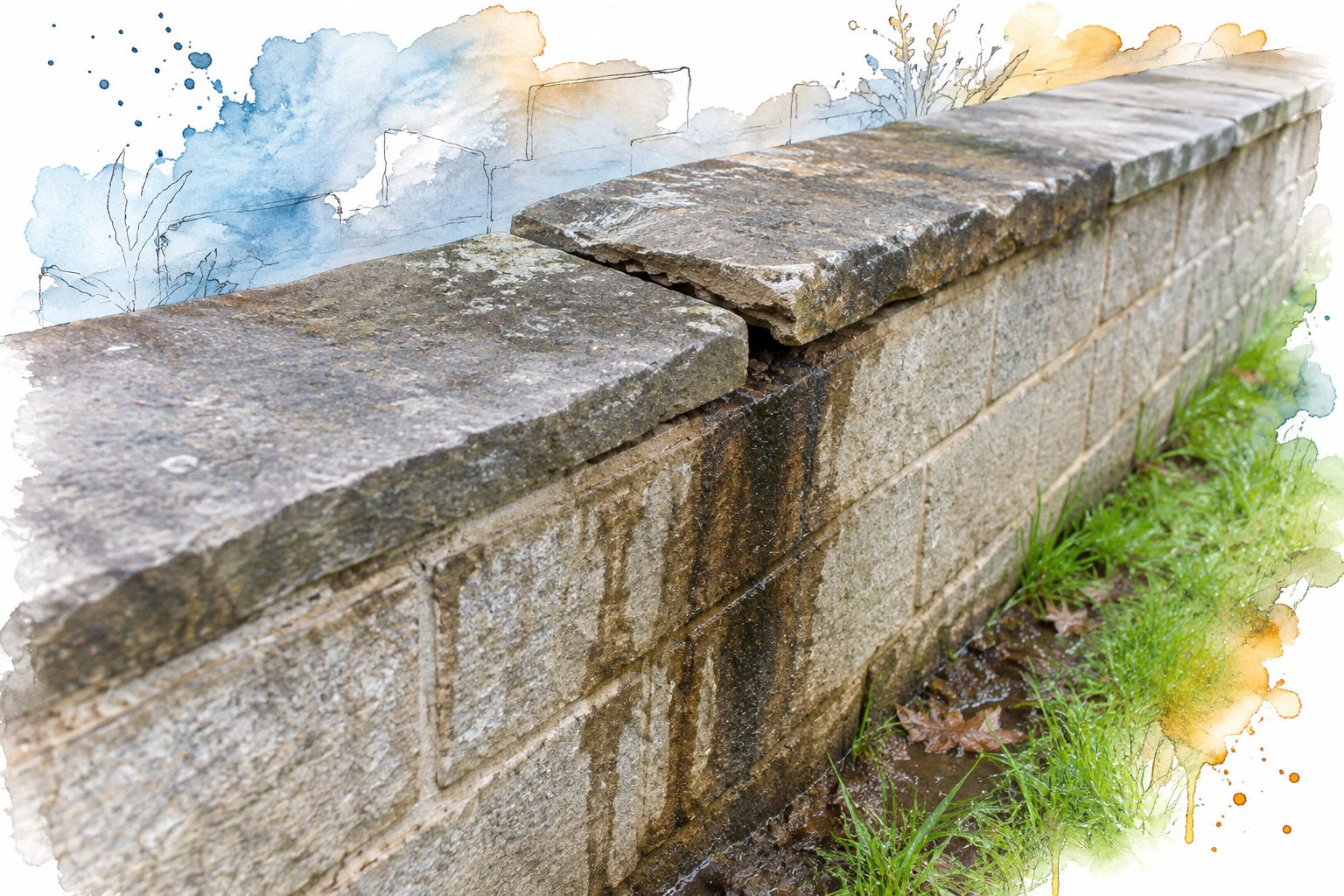
- Look at the bed joint, the horizontal line where the cap meets the wall. Open, crumbling, or missing mortar means water has a door.
- Check the vertical joints between caps for gaps you can slide a business card into.
- Look for dark staining on the face directly under any gap, and for a cap that has slid toward the outside face.
Then the honest triage. A single rocking cap on an otherwise straight wall is usually a reset, and that is a small repair. But when caps have opened up along a whole section, or the cap line no longer reads straight, the wall below probably moved and the cap is just the first thing to show it.
That second case is not a cap job. Resetting caps on a wall that is moving hides the movement for a season and costs you the chance to catch it early. If the wall is also leaning or bulging, start with the signs a retaining wall needs a masonry contractor instead.
Reading What You Found on the Cap Line
This is roughly how I sort it when a homeowner walks me along a wall. It is a starting point, not a diagnosis.
| What you see | What it usually means | Typical next step |
|---|---|---|
| One cap rocks, line is straight | Mortar bed failed under that stone | Reset and repoint that cap |
| Several caps open along a section | Movement below, or long-term saturation | Inspect adjacent courses and base before any cap work |
| Cap slid toward the outside face | Wall is being pushed from behind | Look at drainage and backfill pressure first |
| Cap line dips in the middle | Possible footing or settlement issue | Full wall assessment, not a cap repair |
| Staining under a joint, cap tight | Water entering a vertical joint | Repoint the joint before the wet season |
Where Water Goes When a Cap Comes Loose
A quick visual of the path water takes once the cap stops shedding it.
Why This Winter Changes the Math
I am not in the business of scaring people about weather. But the odds for this coming season have shifted, and that is worth knowing before you decide something can wait until spring.
NOAA’s California Current assessment reports El Nino conditions present and strengthening into winter, with model guidance putting the chance of a very strong event above 90 percent for November through January. That tilts California toward above normal precipitation. It does not promise any single storm.
What it means at the top of a wall is simple: more repeat wetting cycles through the same open joint. One open cap joint that would have shrugged off a dry winter has a different season ahead of it.
That is also why I tell people to look at the whole system, not just the cap. A wall with a failing cap and no working drainage behind it is the combination that fails, which is the point of what a strong El Nino winter does to a wall built without drainage.
The Two Fixes That Backfire
Two things get bought at the hardware store every fall, and both make the top of a wall worse.
Caulk or hard, high-cement mortar across the cap. A rigid band on a wall that moves seasonally does not stop the movement. It just decides where the next crack shows up, and that spot is usually less convenient than the one you covered. On older stone and block, mortar that is harder than the surrounding material will chew the edges of the units instead of giving.
A non-breathable sealer on top of the wall. Masonry is built to let moisture evaporate back out. Trap it inside and you get spalled faces and joints crumbling from within, which is the long version of what a coating traps inside the wall.
I will concede the genuinely small stuff. Clearing debris off the cap, keeping sprinklers from spraying the top course, and trimming a shrub that holds moisture against the wall are all fine weekend work. But the top of a wall is one of the few places where a cheap fix measurably shortens the life of the wall underneath it.
Matching Caps So the Repair Does Not Announce Itself
For homeowners in Carmel and Pebble Beach, the real fear is not the repair. It is a repair you can spot from the driveway for the next twenty years.
Replacing caps on an existing wall is visible work, and a mismatch is permanent. What a mason is actually solving is:
- Sourcing cap stock in the same material, color family, and thickness as what is there
- Matching mortar color to joints that have weathered in salt air for years, not to the bag color
- Matching joint tooling, meaning the profile the original mason struck into the joint
- Planning for age, because new stone reads bright for a season or two before it settles in
Matching is the thing our customers mention most. A Carmel Valley homeowner wrote that the work “matched the stone hardscape around the pool perfectly,” and that is the standard I measure cap repairs against.
So here is the question to ask any mason quoting cap work: how will the new caps and the new mortar color be matched to what is already there, and what will it look like in two years? A good answer is specific. A vague one tells you something too.
Frequently Asked Questions About Masonry Wall Capstone Repair
Can I just reset the loose cap myself?
If it is a small decorative garden wall cap and the wall is sound, that is a reasonable homeowner job. But I would not touch caps on a retaining wall or any wall holding soil, and I would never pry at a cap that is part of a column or corner. Those stones can be heavier and more load-bearing than they look.
What does capstone repair usually cost in Monterey County?
It depends on cap size, material, access, and how many are involved. Resetting a few caps on a sound wall is a small-ticket repair compared with rebuilding a section, while sourcing matching stone for a long run pushes it higher. Access matters more than people expect, since a wall you can back a truck up to and a wall at the bottom of a terraced Carmel Valley lot are not the same job. The only way to get a real number is a site visit.
The caps moved after a vehicle hit my wall. Is that a separate repair?
Usually it is part of the same scope. One Moss Landing property owner described a corner column struck by a utility vehicle with the capstone shifted and partially unsupported, and asked that the surrounding courses be checked too. That instinct is right, because impact damage travels further than the visible break.
How do I know if the wall below moved, not just the cap?
Sight down the cap line and down the face of the wall. A straight cap line with one bad stone is a cap problem. A cap line that curves, dips, or tilts outward means the wall is telling you about something underneath, and that usually traces back to drainage or the footing.
Should I wait until after the rains to deal with it?
If the cap is tight and you only see a hairline joint, spring is fine. If a cap rocks or you can see daylight under it, I would get it closed before January, because every storm runs more water through that same opening.
Thinking about the top of your wall before the rains?
Cap repair after third party damage often runs through an insurer or the responsible party, and that process goes smoother with a licensed, bonded, and insured contractor who will itemize a scope. Any California masonry license can be checked in about a minute through the CSLB check a license tool, which is why Stonecap Masonry publishes CSLB #1073620 and its C-29 masonry classification rather than just referencing a license. The team takes cap and wall assessments across Monterey County, CA ahead of the wet season at 831-262-0442 or stonecapmasonry.com.
